
TechSurge: Deep Tech Podcast
Exploring topics at the intersection of emerging technology, geopolitics, and business.
Hosted by Celesta Capital.


The TechSurge: Deep Tech VC Podcast shares the latest insights directly from legendary Silicon Valley leaders, daring new founders, and visionary technologists.
Join us as we examine the factors shaping the next major technology cycle shift of AI, examine emerging global tech hubs, and analyze where investment dollars are flowing next.
Each discussion delves into the intersection of technology advancement, market dynamics, and the founder journey, offering insights into the vast opportunities and complex challenges ahead.
For entrepreneurs, investors, or anyone interested in where we're headed next, this is your guide to understanding the technologies and companies poised to transform the future.


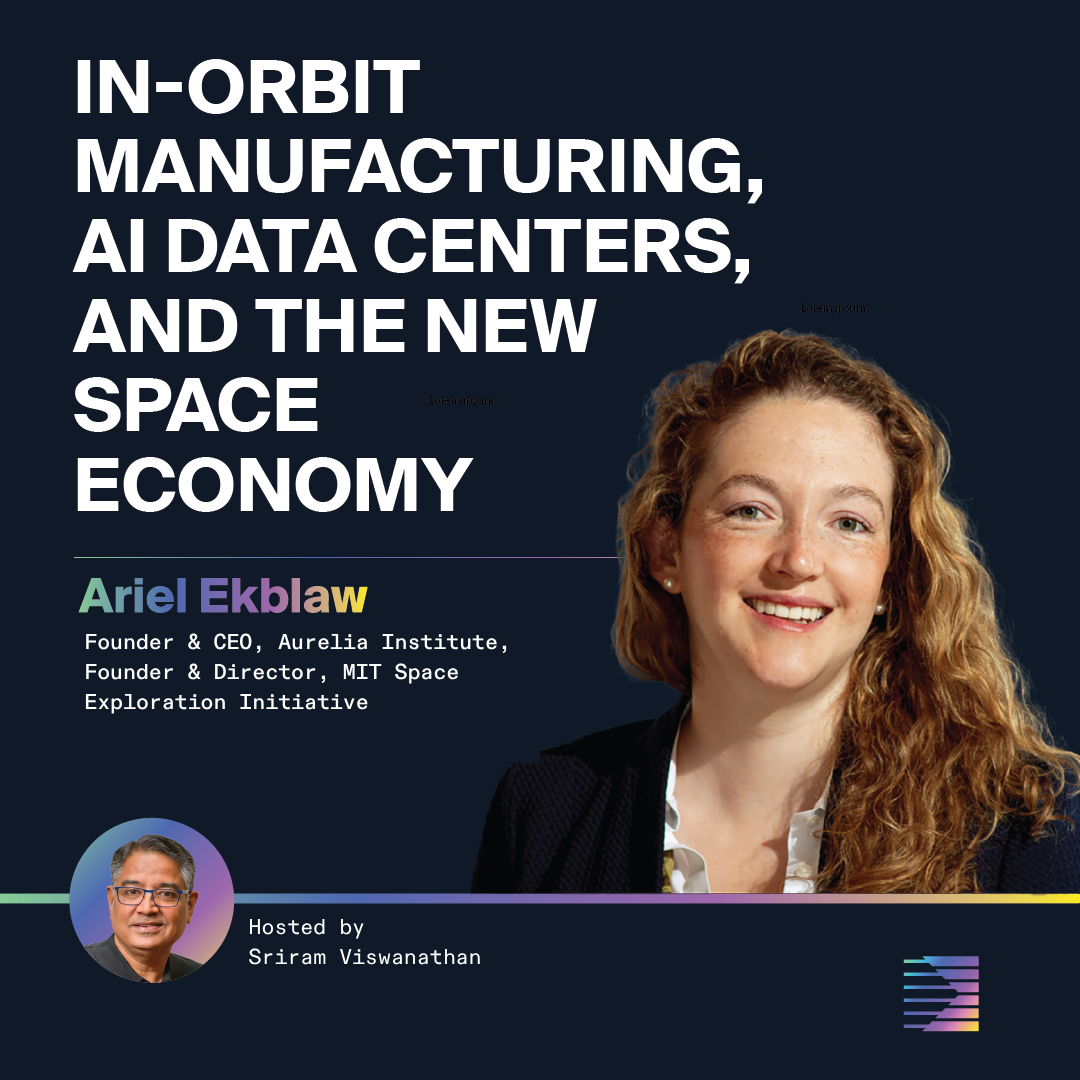
In-Orbit Manufacturing, AI Data Centers, and the New Space Economy with MIT’s Ariel Ekblaw
For most of human history, space has been a place we visited. The next chapter may be about building there.
For decades, space was the domain of governments, astronauts, and science fiction. Today, falling launch costs, reusable rockets, and a new generation of ambitious founders are turning orbit into something else entirely: a place to build. The question is no longer whether humanity can construct large-scale infrastructure in space, but what we should build first-and why.
In this episode of TechSurge, host Sriram Vishwanath speaks with Dr. Ariel Ekblaw, Founder and CEO of Aurelia Institute, Research Affiliate at MIT’s Space Exploration Initiative, and founder of Rendezvous Robotics. Ariel has spent her career exploring one of the most fundamental challenges of the emerging space economy: how to build structures in orbit that are far larger than anything that can fit inside a rocket.
Ariel explains the origins of TESSERAE, her pioneering work on autonomous self-assembling space architecture, and how ideas borrowed from biology, swarm intelligence, and modular construction could unlock a future of massive solar arrays, communications infrastructure, orbital laboratories, and eventually human habitats in space.
The conversation explores the rapidly emerging market for in-orbit infrastructure, including AI data centers in space, space-based solar power, and the technologies needed to support a permanent industrial presence beyond Earth. Ariel breaks down the engineering realities behind these ideas—why cooling data centers in space is harder than most people assume, how autonomous assembly could solve the scale problem, and why the future of orbital infrastructure may look more like a business park than a collection of standalone satellites.
Sriram and Ariel also discuss the broader implications of humanity’s return to space: the economics unlocked by reusable launch systems, the opportunities created by dramatically lower transportation costs, and the second-order innovations that may emerge from building an industrial ecosystem in orbit. Along the way, they examine space debris, stewardship of the orbital commons, artificial gravity, and what it will take to make long-term human habitation in space viable.
At the heart of the discussion is Ariel’s belief that space is not an escape from Earth’s problems, but a tool for solving them. Whether through advanced manufacturing, new energy systems, biotechnology research, or entirely new industries, she argues that the next era of space exploration should be focused on improving life here at home.
Sign up for our newsletter at techsurgepodcast.com for updates on upcoming TechSurge Live Summits and future episodes.
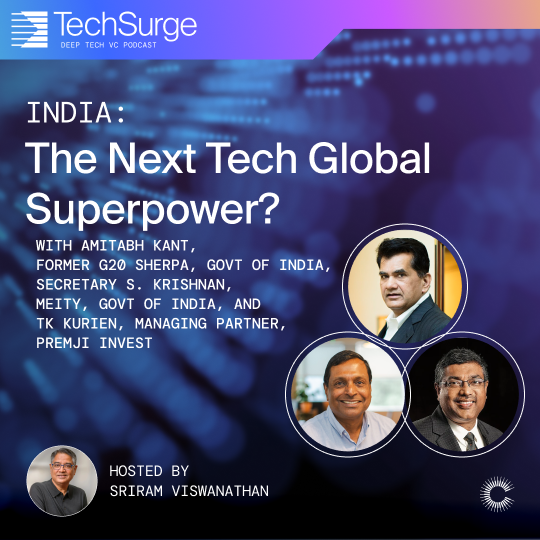
As global supply chains fracture, AI reshapes productivity, and technology becomes a core instrument of national power, India is making an ambitious push to redefine its role in the world economy from IT services provider to deep tech superpower.
In the season 2 premiere of TechSurge, host Sriram Viswanathan brings together three defining perspectives to examine how India is positioned to become a global leader in frontier technologies, and what must go right for that vision to succeed.
The episode begins with S. Krishnan, Secretary at India’s Ministry of Electronics and Information Technology, who outlines how India is treating deep tech as national infrastructure. From the India Semiconductor Mission and AI compute investments to the new RDI (Research, Development & Innovation) framework, Krishnan explains how long-horizon industrial policy is being used to derisk private capital, strengthen domestic design and manufacturing, and accelerate commercialization.
Next, former G20 Sherpa Amitabh Kant places India’s technology ambitions in a global context. As post-WWII institutions weaken and supply chains are redrawn, Amitabh argues that India’s decade of structural reforms, digital public infrastructure, and global partnerships has created a historic opening, if India can sustain free enterprise, execution discipline, and state-level reform.
Finally, T.K. Kurien, CEO and Managing Partner of Premji Inves, brings the investor and operator lens. Kurien explores why India has excelled at services and business-model innovation but lagged in core technology creation and what it will take to build globally dominant deep tech companies. From patient capital and university-led innovation to focused national bets in AI applications, biotech, and semiconductors, he outlines the path from ambition to execution.
Across policy, geopolitics, and capital, one message is clear: India’s deep tech future will not be decided by vision alone but by alignment between government direction, private risk-taking, and long-term discipline.
If you enjoy this episode, please subscribe and leave us a review on your favorite podcast platform.
Sign up for our newsletter at techsurgepodcast.com for updates on upcoming TechSurge Live Summits and future Season 2 episodes.

In TechSurge’s Season 1 Finale episode, we explore an important debate: should AI development be open source or closed?
AI technology leader and UN Senior Fellow Senthil Kumar joins Michael Marks for a deep dive into one of the most consequential debates in artificial intelligence, exploring the fundamental tensions between democratizing AI access and maintaining safety controls.
Sparked by DeepSeek's recent model release that delivered GPT-4 class performance at a fraction of the cost and compute, the discussion spans the economics of AI development, trust and transparency concerns, regulatory approaches across different countries, and the unique opportunities AI presents for developing nations.
From Meta's shift from closed to open and OpenAI's evolution from open to closed, to practical examples of guardrails and the geopolitical implications of AI governance, this episode provides essential insights into how the future of artificial intelligence will be shaped not just by technological breakthroughs, but by the choices we make as a global community.
If you enjoy this episode, please subscribe and leave us a review on your favorite podcast platform. Sign up for our newsletter at techsurgepodcast.com for updates on upcoming TechSurge Live Summits and news about Season 2 of the TechSurge podcast. Thanks for listening!

Legendary technologist and investor Bill Tai joins our latest episode for a wide-ranging conversation spanning decades of Silicon Valley innovation. Bill shares his remarkable journey from being employee #1 at TSMC to becoming one of the first seed investors in Zoom and Canva, and his early embrace of Bitcoin when it was priced at just 7 cents.
The conversation explores Bill's unique investment philosophy shaped by mentorship from Don Valentine of Sequoia Capital, his innovative approach to building entrepreneurial communities through kiteboarding, and his insights into the intersection of AI, energy infrastructure, and cryptocurrency. Bill discusses the massive energy crisis facing AI data centers, drawing parallels to the telecom infrastructure buildout of the 1980s.
From his early days as a kid reverse-engineering electronics to his current role as Chairman of Hut Eight Mining and his partnership with the Trump organization on American Bitcoin Corp, Bill provides invaluable insights into recognizing structural market changes and backing the right entrepreneurs and emerging technologies at the right time.

Will AI displace more jobs than it creates? How can the U.S. win the AI race? How can AI benefits be evenly distributed across businesses and society?
We explore these questions and more as Sriram Viswanathan sits down with Ronnie Chatterji, Chief Economist at OpenAI, for an in-depth exploration of AI's economic impact and policy implications. Ronnie brings a unique perspective, having served as an economic advisor in both the Obama and Biden administrations as a senior economist, supply chain advisor, and architect of the CHIPS Act.
The conversation dives into the economic opportunities and challenges of AI adoption, from productivity gains and job market transformation to the critical need for workforce retraining and AI upskilling in schools. Ronnie also delves into America's competitive position in the global AI race, the critical need for infrastructure investment in order to continue scaling this emerging technology, and the lessons learned from implementing major industrial policy like the CHIPS Act.

In this episode of TechSurge, host Sriram Viswanathan sits down with Nishant Batra, Chief Strategy and Technology Officer at Nokia, for a deep dive into the evolving landscape of telecom and wireless technology. Nishant shares insights into the seismic shifts transforming network infrastructure—from core networks to edge computing—and discusses how Nokia leverages artificial intelligence to optimize performance and drive innovation.
The conversation also highlights Nokia's unique innovation framework, spanning its corporate venture investments, internal incubator, and expansion of the legendary Bell Labs. Today Nokia leverages Bell Labs’ groundbreaking research into emerging technology for internal innovation and new venture spinouts in collaboration with venture capital firms, including recently announced inaugural spinout startup, Astranu.

Competition, growth, tariffs, hacks, AI – what does it take to be an effective leader today? John Chambers, former CEO and Executive Chairman of Cisco and founder of JC2 Ventures, joins TechSurge host Sriram Viswanathan to share valuable wisdom on leading and growing businesses through times of significant change. As a leader who has transitioned from the c-suite to venture capital and now mentoring founders in emerging technology sectors, John has seen it all.
He shares lessons from his time leading one of the world’s most influential networking companies at Cisco (the most valuable company in the world at the time), revealing what he learned while growing it from a challenger networking company into a $50 billion tech powerhouse, sharing how Cisco achieved and maintained its market leadership, particularly his bold M&A strategies.
John offers hard‑won insights on navigating major technology shifts in AI, cloud, security, and more. Today’s founders and executives will find practical frameworks, real‑world war stories, and counterintuitive advice to help survive and thrive in an era of continual disruption.
If you enjoy this episode, please subscribe and leave us a review on your favorite podcast platform. Sign up for our newsletter at techsurgepodcast.com for exclusive insights and updates on upcoming TechSurge Live Summits.

Celesta Capital is a global deep tech venture firm enabling visionary founders at the forefront of scientific and engineering breakthroughs.
Celesta's team has spent decades founding, leading, and scaling global technology businesses, collectively founding more than 40 companies. We understand how to partner with founders to help turn prototypes into powerhouses.
From semiconductors and systems to breakthrough biology, we seek out the physics‑defying, code‑rewriting breakthroughs that will power the next decade of technology advancement.
Follow on Substack.
