
TechSurge: Deep Tech Podcast
Exploring topics at the intersection of emerging technology, geopolitics, and business.
Hosted by Celesta Capital.


The TechSurge: Deep Tech VC Podcast shares the latest insights directly from legendary Silicon Valley leaders, daring new founders, and visionary technologists.
Join us as we examine the factors shaping the next major technology cycle shift of AI, examine emerging global tech hubs, and analyze where investment dollars are flowing next.
Each discussion delves into the intersection of technology advancement, market dynamics, and the founder journey, offering insights into the vast opportunities and complex challenges ahead.
For entrepreneurs, investors, or anyone interested in where we're headed next, this is your guide to understanding the technologies and companies poised to transform the future.


.png)
Patrick Pilarski: Alberta Plan Co-Author On Reinforcement Learning & AI-Powered Prosthetics
For all the competition among AI labs, their primary products are built in much the same way: a large language model is pre-trained on enormous datasets, post-trained, deployed, and refreshed every so often. In 2022, three researchers in Alberta, Canada published a contrarian roadmap for AI that rejects that entire premise.
In this episode of TechSurge, host David Goldman speaks with Patrick Pilarski, who co-wrote the Alberta Plan with Richard Sutton and Michael Bowling. Pilarski is a Canada CIFAR AI Chair, an Amii Fellow, and a professor in the Department of Medicine at the University of Alberta, where his lab builds prosthetic limbs that learn to anticipate what their users intend. In 2017, he was one of three Amii researchers who brought DeepMind’s first international research office to Edmonton, serving as its co-lead until 2023.
The conversation opens with the Alberta Plan’s core premise: an agent that constructs all of its knowledge from its own stream of experience, with no artificial separation between training and deployment, what Pilarski calls “temporal uniformity.” He contrasts this with how today’s major AI labs bolt reinforcement learning onto pre-trained language models during post-training, and addresses head-on why his co-author Rich Sutton has publicly argued that LLMs are a dead end.
Pilarski also breaks news on the podcast: he will soon join ExperienceFlow.AI, a San Francisco-based company with a research lab led scientifically by Richard Sutton, as Head of Edge Superintelligence, focused on bringing continual learning to computing environments where connectivity and compute are limited. He argues that the industry’s massive data center build-out does not lock AI into a single architectural path, and that existing hardware and software stacks have far more flexibility than commonly assumed.
The episode closes with a tour through Pilarski’s own research: how AI-powered prosthetic limbs learn to predict user intent in minutes rather than months, a landmark bone-anchored prosthetic surgery performed in Alberta, and the prospect of supernumerary limbs and wearable technology as a path toward genuine human augmentation. Pilarski also discusses a paper he co-authored arguing that AI agent safety concerns dominating recent headlines are, in fact, reinforcement learning problems the field has studied for decades.
Sign up for our newsletter at techsurgepodcast.com for updates on upcoming TechSurge Live Summits and future episodes.

Every gigawatt of new AI infrastructure now costs $50 to $60 billion to build, roughly $45 billion of which goes straight into GPUs. With more than 400 gigawatts of new compute needed by 2030, the industry faces a roughly $24 trillion capital bill. But according to this week's guest, the real threat to Western AI competitiveness isn't Nvidia, Google, or Broadcom out-maneuvering one another. It's China Inc., which is targeting a cost of under $10 billion per gigawatt, a five- to six-times cost advantage that could reshape who wins the AI infrastructure race.
In this episode of TechSurge, host David Goldman speaks with Raja Koduri, one of the most influential architects in the history of graphics computing. Raja twice led graphics at AMD, directed graphics architecture at Apple, and served as chief architect of Intel's Core and Visual Computing Group. His team helped bring high bandwidth memory to market for AMD's GPUs back in 2015, a technology that now underpins nearly every AI accelerator on the market.
The conversation centers on Raja's new startup, Oxmiq, which he describes as converting "electrons to tokens super efficiently." Raja and David dig into why the bottleneck in AI infrastructure has quietly shifted away from raw compute and toward memory hierarchy, how data moves between SRAM, HBM, and NAND, and between chips, now that models are too large to fit on a single die. Oxmiq's approach uses 3D-stacked, hybrid-bonded memory to unlock 10x the bandwidth of today's HBM and a 10x increase in token generation rate, even on older process nodes.
From there, the discussion turns to how AI coding agents are changing the economics of chip design. Raja argues that spec-writing, once the "boring" 90 percent of the job, is now the hardest and most valuable skill, while writing the code itself is increasingly something agents can handle. He points to OpenAI and Broadcom's Jalapeño chip as evidence that AI-assisted design can compress timelines that used to take multiple generations of custom silicon. Raja also reflects on lessons from building products alongside Steve Jobs at Apple and Lisa Su at AMD, and explains why he believes Intel's decision to kill 3D XPoint memory came at exactly the wrong moment.
The episode closes with Raja's outlook on where AI infrastructure goes next: a future of both massive "token factories" and smaller, personal "token banks," a shift he compares to the transition offices went through with server rooms, becoming invisible infrastructure that simply works. As he puts it, "the more boring you make it, the more it becomes fabulous."
Sign up for our newsletter at techsurgepodcast.com for updates on upcoming TechSurge Live Summits and future episodes.
.png)
Almost 2% of U.S. GDP will be spent on AI infrastructure this year, nearly double 2025's figure. But beneath those headline numbers, the composition of that spending has quietly flipped: for the first time, dollars spent on running models in production now outweigh dollars spent training them.
In this episode of TechSurge, host David Goldman speaks with Austin Lyons, a semiconductor analyst at Creative Strategies, co-host of the Semi Doped podcast, and author of the Chipstrat newsletter. Lyons previously worked as a hardware engineer at Intel and as a product manager on John Deere's autonomous tractor and Blue River Technology teams before turning to full-time chip industry analysis.
The conversation opens with why AI buyers have moved from assembling commoditized parts to buying entire pre-integrated systems, tracing how Nvidia's rack-scale approach, exemplified by its 72-GPU Grace Blackwell racks, made turnkey deployment the default, and why that raises the bar for any chip startup trying to compete. Lyons and Goldman then unpack how inference workloads have split into two distinct problems, prefill and decode, and how that split created an opening for SRAM-based challengers to outperform general-purpose GPUs on decode speed.
From there, the discussion turns to the rise of neoclouds, the GPU-rental companies that grew into public businesses worth well over $100 billion combined, and why so many traditional investors missed them. Lyons and Goldman work through the circular financing debate head-on: the mechanics of Nvidia's equity stakes, GPU-backed debt, and hyperscaler off-take agreements that critics compare to dot-com-era vendor financing, and the counterargument that demand is simply outrunning fixed supply.
The episode closes on Lyons's own framework for identifying the next trillion-dollar chip company, built on four conditions including the ability to run trillion-parameter models at rack scale, beat an incumbent on a key performance metric, and land a frontier anchor customer, along with a look at how AI-assisted chip design is lowering the barrier for more companies, from OpenAI to electric vehicle makers, to design their own custom silicon.
Sign up for our newsletter at techsurgepodcast.com for updates on upcoming TechSurge Live Summits and future episodes.
.png)
In this episode, Nobel Prize-winning physicist Dr. John Martinis reveals how his breakthrough in superconducting qubits made quantum physics real at macroscopic scale and what it means for the future of technology. The former lead of Google's Quantum AI lab explains why quantum computing is so fragile, why a lot of hype has a low chance to work, and why his fabless company Qolab could be the Nvidia of quantum computing.
In this conversation, Dr. Martinis joins Tech Surge to explain the science behind macroscopic quantum coherence, the engineering challenges of scaling quantum computers, and how hybrid quantum-classical computing will shape the future of technology.
The conversation covers:
✅ How the superconducting qubit breakthrough won the Nobel Prize in Physics
✅ Why Nature wants to destroy quantum coherence and why quantum is fragile
✅ From academic physics to building Google's quantum computer
✅ The engineering challenge of scaling quantum computing beyond the lab
✅ Why a lot of quantum computing hype has a low chance to work
✅ How Qolab's fabless model could scale quantum hardware
Sign up for our newsletter at techsurgepodcast.com for updates on upcoming TechSurge Live Summits and future episodes.
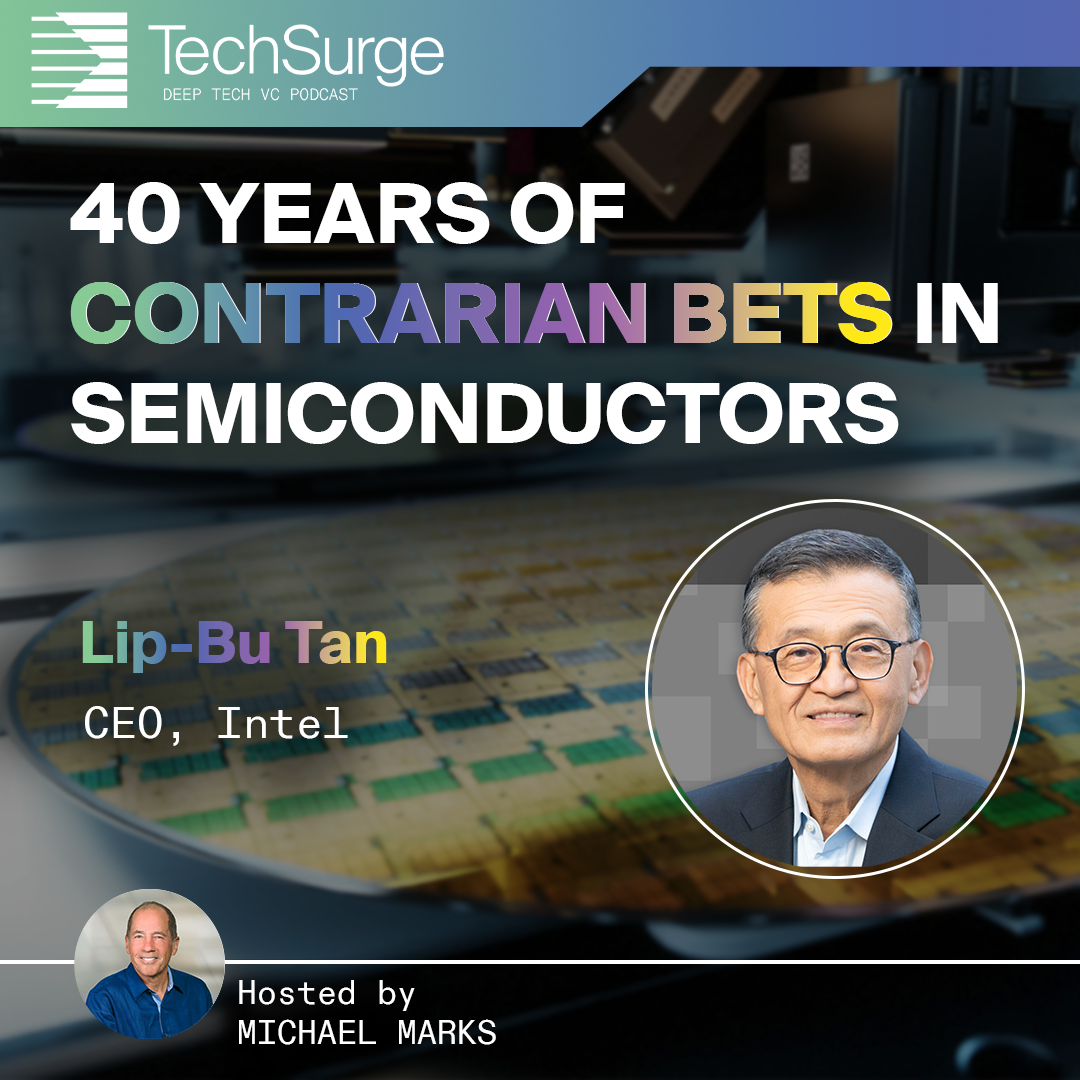
Silicon Valley was built on semiconductors, but for nearly two decades, venture capital shifted its attention towards software. Today, AI is changing that as the demand for compute, memory and networking explodes, hardware is once again at the centre of the industry's biggest bets.
In this episode of TechSurge, host Michael Marks speaks with Lip-Bu Tan, CEO of Intel and one of the semiconductor industry's most influential investors and executives. The conversation traces Tan's journey from studying nuclear engineering at MIT to leading Cadence's turnaround, investing in more than 500 technology companies, and now steering Intel through one of the most significant transformations in its history.
Tan shares his VC conviction on backing semiconductor startups when most venture investors favored software, and why he believes AI's next breakthroughs will come from advances in memory, packaging, photonics, cooling and high-speed connectivity. He also opens up on the leadership philosophy that defined his time at Cadence, where listening to customers and building a culture of responsiveness became the foundation of the company's revival.
Wearing his CEO hat, Tan explains Intel's long-term strategy, why vertical integration still matters, how the company plans to reconnect with the startup ecosystem, and why missing another technology wave is not an option.
Sign up for our newsletter at techsurgepodcast.com for updates on upcoming TechSurge Live Summits and future episodes.

Artificial intelligence is often discussed through models and GPUs. This episode looks beneath that surface, at the power delivery and networking required to make AI work at scale.
Host Sriram Viswanathan speaks with Rajiv Khemani, a serial deep tech entrepreneur whose career has tracked several major infrastructure cycles: internet networking, cloud switching, blockchain compute and now AI networking. Khemani reflects on his early work at NetBoost and Intel, his operating role at Cavium, and the founding of Innovium, which Marvell agreed to acquire for $1.1 billion in 2021. He also explains how work on low-power blockchain silicon led his team toward the infrastructure demands created by generative AI.
The discussion examines why incumbents often overlook emerging markets, why purpose-built hardware can outperform systems inherited from an earlier technology cycle, and how founders decide whether to keep financing a company or sell while the outcome remains attractive. Khemani describes the concentration risk of selling to a small number of hyperscalers, the fragility of semiconductor supply chains, and why leading-edge chip development now demands much larger balance sheets.
The conversation then turns to AI’s emerging bottlenecks. Large models require many accelerators to operate as one computer, making low-latency scale-up and scale-out networks central to performance. The episode explores heterogeneous compute, open networking standards, memory scarcity, AI’s growing electricity demand, and the competition between AI and Bitcoin mining for energy.
Sign up for our newsletter at techsurgepodcast.com for updates on upcoming TechSurge Live Summits and future episodes.

Canada produces world-leading science, engineering, and AI research. So why does so much of that research still commercialize outside of Canada?
In this episode of TechSurge, host Nic Brathwaite puts that question to four leaders at two of Canada's top research universities: Mary Wells (Dean of Engineering) and Chris Houser (Dean of Science) at the University of Waterloo, and Heather Sheardown (Dean of Engineering) and Gianni Parise (VP Research) at McMaster.
At Waterloo, Mary Wells traces how the university's origin produced one of the world's most influential co-op programs and a creator-owned IP policy that lets inventors keep their ideas, making the school a talent engine for global tech. The group digs into Canada's AI paradox, foundational research and talent but far less of the economic value, and what quantum, robotics, and advanced manufacturing show about getting research to market.
McMaster runs a different model, built on health sciences, nuclear research, and problem-based learning. Heather Sheardown explains the McMaster Method and why it matters in an AI-shaped future. Gianni Parise argues for commercialization as a core university function, with work spanning AI-assisted drug discovery, inhaled vaccines, critical-mineral-free motors, and a campus nuclear reactor that supplies much of the world's iodine-125 for prostate cancer treatment. They also unpack Fusion Pharmaceuticals, the McMaster spin-out acquired by AstraZeneca, and what it reveals about university commercialization.
Together, these conversations ask what universities must become in an era defined by AI, deep tech, national competitiveness, and the urgent need to move ideas from the lab into the world.
Sign up for our newsletter at techsurgepodcast.com for updates on upcoming TechSurge Live Summits and future episodes.

Celesta Capital is a global deep tech venture firm enabling visionary founders at the forefront of scientific and engineering breakthroughs.
Celesta's team has spent decades founding, leading, and scaling global technology businesses, collectively founding more than 40 companies. We understand how to partner with founders to help turn prototypes into powerhouses.
From semiconductors and systems to breakthrough biology, we seek out the physics‑defying, code‑rewriting breakthroughs that will power the next decade of technology advancement.
Follow on Substack.
