
TechSurge: Deep Tech Podcast
Exploring topics at the intersection of emerging technology, geopolitics, and business.
Hosted by Celesta Capital.


The TechSurge: Deep Tech VC Podcast shares the latest insights directly from legendary Silicon Valley leaders, daring new founders, and visionary technologists.
Join us as we examine the factors shaping the next major technology cycle shift of AI, examine emerging global tech hubs, and analyze where investment dollars are flowing next.
Each discussion delves into the intersection of technology advancement, market dynamics, and the founder journey, offering insights into the vast opportunities and complex challenges ahead.
For entrepreneurs, investors, or anyone interested in where we're headed next, this is your guide to understanding the technologies and companies poised to transform the future.


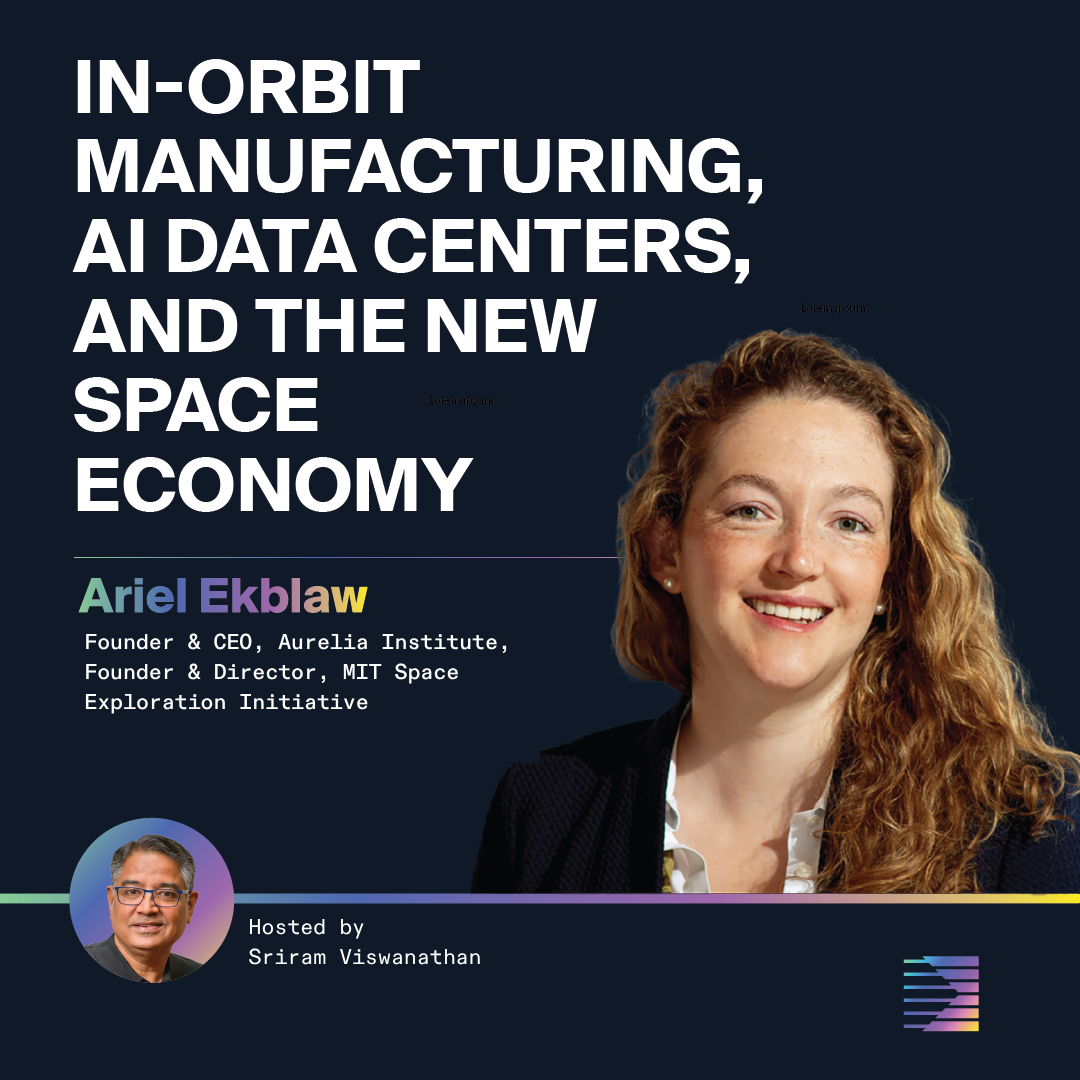
In-Orbit Manufacturing, AI Data Centers, and the New Space Economy with MIT’s Ariel Ekblaw
For most of human history, space has been a place we visited. The next chapter may be about building there.
For decades, space was the domain of governments, astronauts, and science fiction. Today, falling launch costs, reusable rockets, and a new generation of ambitious founders are turning orbit into something else entirely: a place to build. The question is no longer whether humanity can construct large-scale infrastructure in space, but what we should build first-and why.
In this episode of TechSurge, host Sriram Vishwanath speaks with Dr. Ariel Ekblaw, Founder and CEO of Aurelia Institute, Research Affiliate at MIT’s Space Exploration Initiative, and founder of Rendezvous Robotics. Ariel has spent her career exploring one of the most fundamental challenges of the emerging space economy: how to build structures in orbit that are far larger than anything that can fit inside a rocket.
Ariel explains the origins of TESSERAE, her pioneering work on autonomous self-assembling space architecture, and how ideas borrowed from biology, swarm intelligence, and modular construction could unlock a future of massive solar arrays, communications infrastructure, orbital laboratories, and eventually human habitats in space.
The conversation explores the rapidly emerging market for in-orbit infrastructure, including AI data centers in space, space-based solar power, and the technologies needed to support a permanent industrial presence beyond Earth. Ariel breaks down the engineering realities behind these ideas—why cooling data centers in space is harder than most people assume, how autonomous assembly could solve the scale problem, and why the future of orbital infrastructure may look more like a business park than a collection of standalone satellites.
Sriram and Ariel also discuss the broader implications of humanity’s return to space: the economics unlocked by reusable launch systems, the opportunities created by dramatically lower transportation costs, and the second-order innovations that may emerge from building an industrial ecosystem in orbit. Along the way, they examine space debris, stewardship of the orbital commons, artificial gravity, and what it will take to make long-term human habitation in space viable.
At the heart of the discussion is Ariel’s belief that space is not an escape from Earth’s problems, but a tool for solving them. Whether through advanced manufacturing, new energy systems, biotechnology research, or entirely new industries, she argues that the next era of space exploration should be focused on improving life here at home.
Sign up for our newsletter at techsurgepodcast.com for updates on upcoming TechSurge Live Summits and future episodes.

MIT President Emeritus Dr. Rafael Reif joins host Michael Marks for a discussion about the state of U.S. competitiveness in technology, university research funding, current immigration policy, and more. Reif explains why universities remain the innovation engines of economies, educating top talent and generating the foundational research that powers emerging tech and creates new industries. He candidly assesses U.S.-China competition, warns that Chinese research output is rapidly outpacing our own, and urges renewed federal investment.
The discussion explores how restrictive immigration policies threaten the flow of global talent into the U.S and his own impression of current policies as an immigrant from Venezuela himself. As a TSMC board member, Reif also touches on the strategic need for domestic semiconductor fabs, Intel’s path forward, and TSMC’s edge in advancing cutting-edge nodes. Lastly, he addresses gaps in the venture capital funding space and why he created MIT’s The Engine incubator model to fund “tough tech” startups, which helped launch breakthroughs like Commonwealth Fusion Systems.
If you enjoy this episode, please subscribe and leave us a review on your favorite podcast platform. Sign up for our newsletter at techsurgepodcast.com for exclusive insights and updates on upcoming TechSurge Live Summits.

Bobby Yerramilli-Rao, Chief Strategy Officer at Microsoft, joins TechSurge host Sriram Viswanathan to offer a rare glimpse into the strategic playbook of one of the world’s most powerful tech companies. Bobby shares how the company navigates today’s biggest technology paradigm shifts, placing bets with trillion-dollar implications. Touching on Microsoft’s AI strategy, OpenAI partnership, quantum computing, its approach to acquisitions, and much more, this candid and wide-ranging conversation is not to be missed.
If you enjoy this episode, please subscribe and leave us a review on your favorite podcast platform. Sign up for our newsletter at techsurgepodcast.com for exclusive insights and updates on upcoming TechSurge Live Summits.

In this episode of TechSurge, host Sriram Viswanathan sits down with Charlie Giancarlo, Chairman and CEO of Pure Storage, to discuss the evolution and future of data storage in the digital age. Charlie shares insights from his career spanning his pivotal role in Cisco's success as a networking pioneer, to his leadership in transforming Pure Storage into a leader in innovative storage solutions.
They explore the evolution of data center infrastructure, and the critical role of storage architecture in enabling AI and cloud technologies. Charlie also explains how Pure Storage's software-driven approach is creating new efficiencies and opportunities for enterprises, offering a compelling vision for a unified "data cloud" that breaks down data silos and unlocks new insights.
This episode delves into the intersections of networking, compute, storage, and AI, providing an essential perspective for anyone interested in the future of technology infrastructure.
If you enjoy this episode, please subscribe and leave us a review on your favorite podcast platform. Sign up for our newsletter at techsurgepodcast.com for exclusive insights and updates on upcoming TechSurge Live Summits.

Many in venture capital and biopharma are anointing artificial intelligence the savior of drug discovery—but what can AI actually do?
In this eye-opening episode, Michael Marks sits down with Mike Nohaile, CEO of Prellis Biologics, to explore the hype versus reality in AI-enabled drug discovery. Mike details why, despite significant breakthroughs like AlphaFold and recent Nobel Prize win for computational protein design, fully AI-generated medicines still present challenges. He also discusses why we urgently need more effective medicines and details Prellis’ unique system which combines laser printed human organoids and an externalized human immune system with AI, enabling the discovery of fully human antibodies.
If you enjoy this episode, please subscribe and leave us a review on your favorite podcast platform. Sign up for our newsletter at techsurgepodcast.com for exclusive insights and updates on upcoming TechSurge Live Summits.

Artificial intelligence is evolving at an unprecedented pace—what does that mean for the future of technology, venture capital, business, and even our understanding of ourselves?
Award-winning journalist and writer Anil Ananthaswamy joins us for our latest episode to discuss his latest book Why Machines Learn: The Elegant Math Behind Modern AI.
Anil helps us explore the journey and many breakthroughs that have propelled machine learning from simple perceptrons to the sophisticated algorithms shaping today’s AI revolution, powering GPT and other models. The discussion aims to demystify some of the underlying math that powers modern machine learning to help everyone grasp this technology impacting our lives, even if your last math class was in high school.
Anil walks us through the power of scaling laws, the shift from training to inference optimization, and the debate among AI’s pioneers about the road to AGI—should we be concerned, or are we still missing key pieces of the puzzle? The conversation also delves into AI’s philosophical implications—could understanding how machines learn help us better understand ourselves? And what challenges remain before AI systems can truly operate with agency?
If you enjoy this episode, please subscribe and leave us a review on your favorite podcast platform. Sign up for our newsletter at techsurgepodcast.com for exclusive insights and updates on upcoming TechSurge Live Summits.

With global economic alliances shifting and new threats emerging, will the U.S. maintain its dominance in an increasingly complex world?
From cryptocurrency to chips to cyberterrorist threats, the battle for global dominance is no longer just fought on the battlefield—it’s playing out in markets, boardrooms, and cyberspace. In this episode, we sit down with Juan Zarate, a key member of the post-9/11 Bush Administration team fighting terrorist financing and financial crimes, and an architect of how we view modern financial warfare.
We explore how the U.S. has used its economic dominance as a powerful weapon—and whether countries like China and Russia are now using the same playbook to push back. Juan shares insights on the weaponization of the dollar, how financial crime networks are evolving in the digital age, and why strategies around cryptocurrency could either threaten or reinforce U.S. economic power.
The conversation dives into the intersection of technology, economic, and national security strategy, tackling key issues like cyber threats, semiconductor supply chains, and the growing role of AI in financial security. Juan also introduces his latest venture, Consilient, which is pioneering federated AI to revolutionize the fight against financial crime.

Celesta Capital is a global deep tech venture firm enabling visionary founders at the forefront of scientific and engineering breakthroughs.
Celesta's team has spent decades founding, leading, and scaling global technology businesses, collectively founding more than 40 companies. We understand how to partner with founders to help turn prototypes into powerhouses.
From semiconductors and systems to breakthrough biology, we seek out the physics‑defying, code‑rewriting breakthroughs that will power the next decade of technology advancement.
Follow on Substack.
