
TechSurge: Deep Tech Podcast
Exploring topics at the intersection of emerging technology, geopolitics, and business.
Hosted by Celesta Capital.


The TechSurge: Deep Tech VC Podcast shares the latest insights directly from legendary Silicon Valley leaders, daring new founders, and visionary technologists.
Join us as we examine the factors shaping the next major technology cycle shift of AI, examine emerging global tech hubs, and analyze where investment dollars are flowing next.
Each discussion delves into the intersection of technology advancement, market dynamics, and the founder journey, offering insights into the vast opportunities and complex challenges ahead.
For entrepreneurs, investors, or anyone interested in where we're headed next, this is your guide to understanding the technologies and companies poised to transform the future.


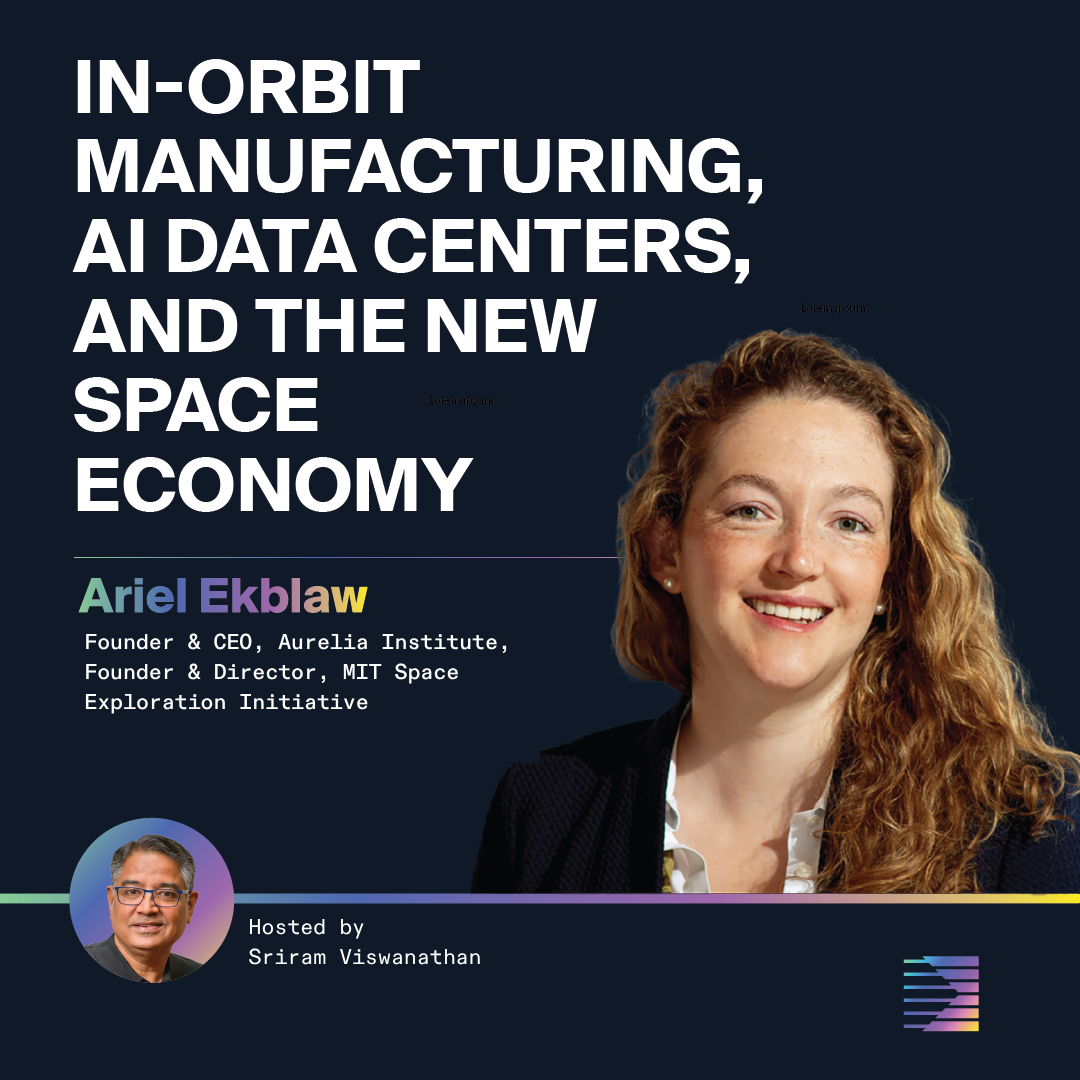
In-Orbit Manufacturing, AI Data Centers, and the New Space Economy with MIT’s Ariel Ekblaw
For most of human history, space has been a place we visited. The next chapter may be about building there.
For decades, space was the domain of governments, astronauts, and science fiction. Today, falling launch costs, reusable rockets, and a new generation of ambitious founders are turning orbit into something else entirely: a place to build. The question is no longer whether humanity can construct large-scale infrastructure in space, but what we should build first-and why.
In this episode of TechSurge, host Sriram Vishwanath speaks with Dr. Ariel Ekblaw, Founder and CEO of Aurelia Institute, Research Affiliate at MIT’s Space Exploration Initiative, and founder of Rendezvous Robotics. Ariel has spent her career exploring one of the most fundamental challenges of the emerging space economy: how to build structures in orbit that are far larger than anything that can fit inside a rocket.
Ariel explains the origins of TESSERAE, her pioneering work on autonomous self-assembling space architecture, and how ideas borrowed from biology, swarm intelligence, and modular construction could unlock a future of massive solar arrays, communications infrastructure, orbital laboratories, and eventually human habitats in space.
The conversation explores the rapidly emerging market for in-orbit infrastructure, including AI data centers in space, space-based solar power, and the technologies needed to support a permanent industrial presence beyond Earth. Ariel breaks down the engineering realities behind these ideas—why cooling data centers in space is harder than most people assume, how autonomous assembly could solve the scale problem, and why the future of orbital infrastructure may look more like a business park than a collection of standalone satellites.
Sriram and Ariel also discuss the broader implications of humanity’s return to space: the economics unlocked by reusable launch systems, the opportunities created by dramatically lower transportation costs, and the second-order innovations that may emerge from building an industrial ecosystem in orbit. Along the way, they examine space debris, stewardship of the orbital commons, artificial gravity, and what it will take to make long-term human habitation in space viable.
At the heart of the discussion is Ariel’s belief that space is not an escape from Earth’s problems, but a tool for solving them. Whether through advanced manufacturing, new energy systems, biotechnology research, or entirely new industries, she argues that the next era of space exploration should be focused on improving life here at home.
Sign up for our newsletter at techsurgepodcast.com for updates on upcoming TechSurge Live Summits and future episodes.

In this episode of TechSurge: The Deep Tech Podcast, host Nicholas Brathwaite of Celesta Capital speaks with Christian Mitchell, Chief Digital and Information Officer at Northwestern Mutual, about the profound digital transformation happening in the financial services and insurance sectors. The discussion covers how legacy systems are being modernized, the role of AI in enhancing underwriting and customer experiences, and the increasing importance of cybersecurity in safeguarding sensitive data.
Christian also shares insights on the evolution of FinTech startups and Northwestern Mutual’s approach to investing in and partnering with innovative tech companies, providing a deep dive into how technology is reshaping long-established industries while balancing innovation with regulatory and customer needs.

In this episode, we explore the future of mobility and AI with Aicha Evans, CEO of Zoox, a leading developer of autonomous robotaxis and an Amazon company. Joining Celesta Capital’s founding partner Sriram Viswanathan, Aicha shares her journey from Senegal to Silicon Valley, where she led groundbreaking innovations at Intel before taking the helm at Zoox.
Together, they discuss the challenges and opportunities in autonomous transportation, the evolving role of AI in various industries, and the critical importance of safety, customer experience, and scaling in the robotaxi space.
Tune in for insights on the future of transportation and the transformative potential of AI in shaping our daily lives.

Will AI will take away all of our jobs? Is technology eroding privacy? Is the pace of technology advancement too fast?
We address these questions and more topics around global science and technology policy with Rob Atkinson, founder and president of the Information Technology and Innovation Foundation. Speaking with Celesta Capital founding partner Nic Brathwaite, Rob dives into the intersection of technology, innovation, and public policy, covering topics such as ethical AI, the role of China in the global innovation race, and the realities facing smaller economies in blossoming into tech hubs. Rob shares his insights on innovation economics, government policy, and the critical role of entrepreneurs in shaping the future of tech.

Fred Thiel, Chairman and CEO of Marathon Digital, dives us into the world of blockchain and cryptocurrency mining. Fred discusses the technological advancements in Bitcoin mining, including significant improvements in energy efficiency, and provides insights into the future of Bitcoin, predicting substantial growth in its value and its linkages with AI inference data centers. He also explains the relationship between Bitcoin and global economic factors, the potential for regulatory changes, and the evolving role of cryptocurrencies in both developed and developing markets, highlighting Bitcoin’s growing role as a store of value and a driver of financial sovereignty in the digital age.

Micron CEO Sanjay Mehrotra discusses his journey in the semiconductor industry and the growing strategic importance of the memory industry in the age of AI. He highlights innovation in high bandwidth memory (HBM), which enables faster data access and lower power consumption. Sanjay also discusses Micron’s plans to build new U.S. semiconductor factories and the role of the CHIPS Act in bringing semiconductor manufacturing back to the U.S. He shares his insights on the resurgence of hardware innovation and what it takes to drive technological leadership in a rapidly evolving industry.

Former CEO of PepsiCo and New York Times bestselling author Indra Nooyi joins host Michael Marks for a wide-ranging conversation to share her insights on the growth of big tech companies, the impact of AI, CEO-board relationships, and much more.
Indra currently serves on the boards of Amazon, Phillips, Memorial Sloan Kettering Cancer Center, the National Gallery of Art, and is a Dean’s Advisory Council Member at MIT School of Engineering. Her New York Times bestselling memoir My Life In Full offers insight and a call-to-action from one of the world’s most-admired business leaders on how our society can blend work and family — and advance women — in the 21st century. She is widely considered to be one of the world’s top CEOs for her leadership at global giant PepsiCo over 12 years.

Celesta Capital is a global deep tech venture firm enabling visionary founders at the forefront of scientific and engineering breakthroughs.
Celesta's team has spent decades founding, leading, and scaling global technology businesses, collectively founding more than 40 companies. We understand how to partner with founders to help turn prototypes into powerhouses.
From semiconductors and systems to breakthrough biology, we seek out the physics‑defying, code‑rewriting breakthroughs that will power the next decade of technology advancement.
Follow on Substack.
