
TechSurge: Deep Tech Podcast
Exploring topics at the intersection of emerging technology, geopolitics, and business.
Hosted by Celesta Capital.


The TechSurge: Deep Tech VC Podcast shares the latest insights directly from legendary Silicon Valley leaders, daring new founders, and visionary technologists.
Join us as we examine the factors shaping the next major technology cycle shift of AI, examine emerging global tech hubs, and analyze where investment dollars are flowing next.
Each discussion delves into the intersection of technology advancement, market dynamics, and the founder journey, offering insights into the vast opportunities and complex challenges ahead.
For entrepreneurs, investors, or anyone interested in where we're headed next, this is your guide to understanding the technologies and companies poised to transform the future.


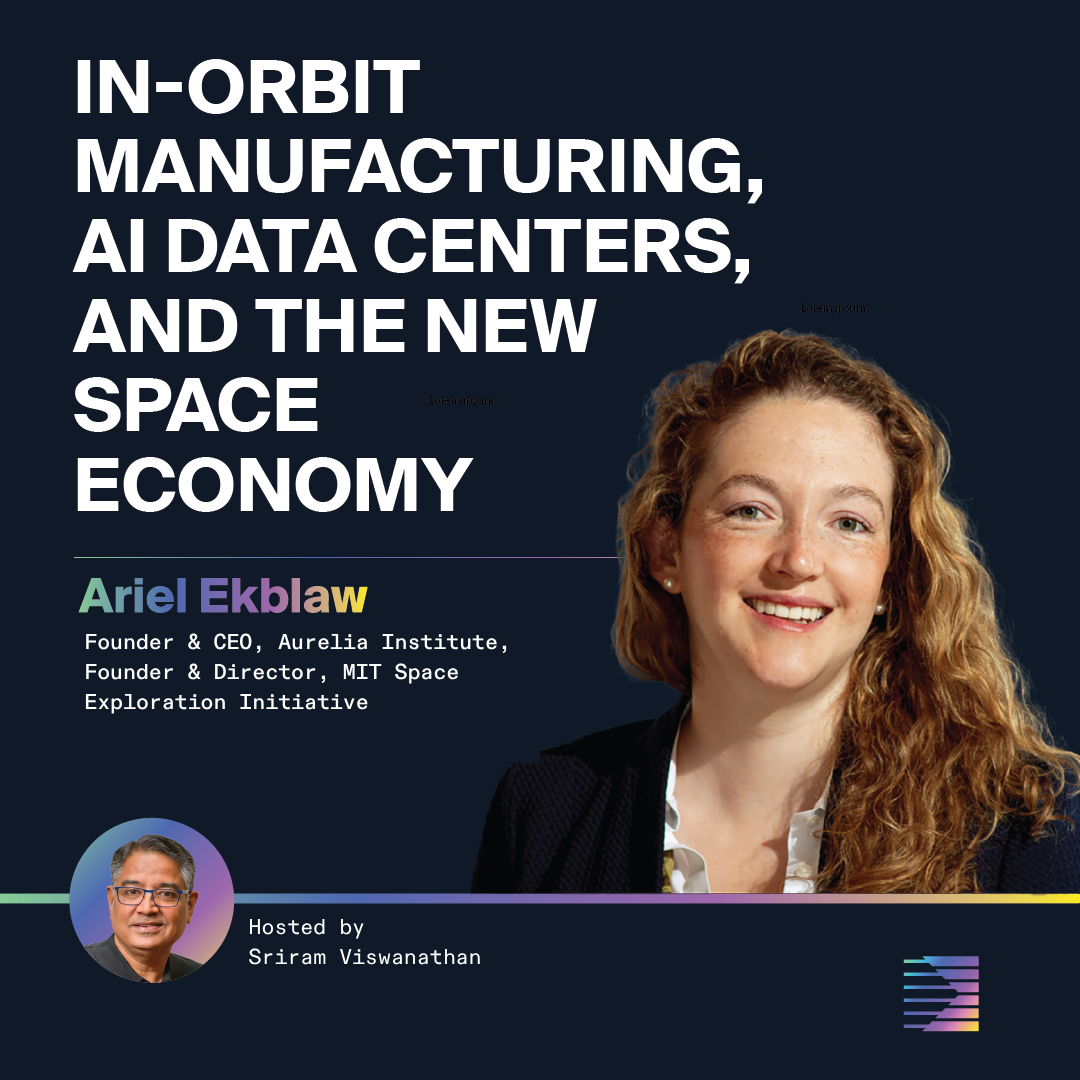
In-Orbit Manufacturing, AI Data Centers, and the New Space Economy with MIT’s Ariel Ekblaw
For most of human history, space has been a place we visited. The next chapter may be about building there.
For decades, space was the domain of governments, astronauts, and science fiction. Today, falling launch costs, reusable rockets, and a new generation of ambitious founders are turning orbit into something else entirely: a place to build. The question is no longer whether humanity can construct large-scale infrastructure in space, but what we should build first-and why.
In this episode of TechSurge, host Sriram Vishwanath speaks with Dr. Ariel Ekblaw, Founder and CEO of Aurelia Institute, Research Affiliate at MIT’s Space Exploration Initiative, and founder of Rendezvous Robotics. Ariel has spent her career exploring one of the most fundamental challenges of the emerging space economy: how to build structures in orbit that are far larger than anything that can fit inside a rocket.
Ariel explains the origins of TESSERAE, her pioneering work on autonomous self-assembling space architecture, and how ideas borrowed from biology, swarm intelligence, and modular construction could unlock a future of massive solar arrays, communications infrastructure, orbital laboratories, and eventually human habitats in space.
The conversation explores the rapidly emerging market for in-orbit infrastructure, including AI data centers in space, space-based solar power, and the technologies needed to support a permanent industrial presence beyond Earth. Ariel breaks down the engineering realities behind these ideas—why cooling data centers in space is harder than most people assume, how autonomous assembly could solve the scale problem, and why the future of orbital infrastructure may look more like a business park than a collection of standalone satellites.
Sriram and Ariel also discuss the broader implications of humanity’s return to space: the economics unlocked by reusable launch systems, the opportunities created by dramatically lower transportation costs, and the second-order innovations that may emerge from building an industrial ecosystem in orbit. Along the way, they examine space debris, stewardship of the orbital commons, artificial gravity, and what it will take to make long-term human habitation in space viable.
At the heart of the discussion is Ariel’s belief that space is not an escape from Earth’s problems, but a tool for solving them. Whether through advanced manufacturing, new energy systems, biotechnology research, or entirely new industries, she argues that the next era of space exploration should be focused on improving life here at home.
Sign up for our newsletter at techsurgepodcast.com for updates on upcoming TechSurge Live Summits and future episodes.

Driven both by surging demand and rapid technology advancements, an emerging area of health innovation called “bioconvergence” is driving improvements in human health and sustained interest from investors. This episode will explore these new applications merging engineered technologies with scientific disciplines, including in diagnostics, therapeutics, and elsewhere.
Nobel Laureate Dr. Jim Rothman, Dr. Melanie Mathieu of Prellis Biologics, and Daniel Dornbusch of Excision join host Michael Marks for an in-depth discussion covering advancements in CRISPR technology, the role of AI in drug discovery, the future of personalized medicine, and much more.

Legendary technology founder and venture investor Vinod Khosla joins host Michael Marks for a wide-ranging discussion on the future of AI, major tech cycles, the importance of being honest with founders, and much more. Vinod shares his predictions for the next 25 years of technology advancement and how we should be assessing the risks and benefits as the adoption of artificial intelligence continues to accelerate.

Celesta Capital is a global deep tech venture firm enabling visionary founders at the forefront of scientific and engineering breakthroughs.
Celesta's team has spent decades founding, leading, and scaling global technology businesses, collectively founding more than 40 companies. We understand how to partner with founders to help turn prototypes into powerhouses.
From semiconductors and systems to breakthrough biology, we seek out the physics‑defying, code‑rewriting breakthroughs that will power the next decade of technology advancement.
Follow on Substack.
