
TechSurge: Deep Tech Podcast
Exploring topics at the intersection of emerging technology, geopolitics, and business.
Hosted by Celesta Capital.


The TechSurge: Deep Tech VC Podcast shares the latest insights directly from legendary Silicon Valley leaders, daring new founders, and visionary technologists.
Join us as we examine the factors shaping the next major technology cycle shift of AI, examine emerging global tech hubs, and analyze where investment dollars are flowing next.
Each discussion delves into the intersection of technology advancement, market dynamics, and the founder journey, offering insights into the vast opportunities and complex challenges ahead.
For entrepreneurs, investors, or anyone interested in where we're headed next, this is your guide to understanding the technologies and companies poised to transform the future.


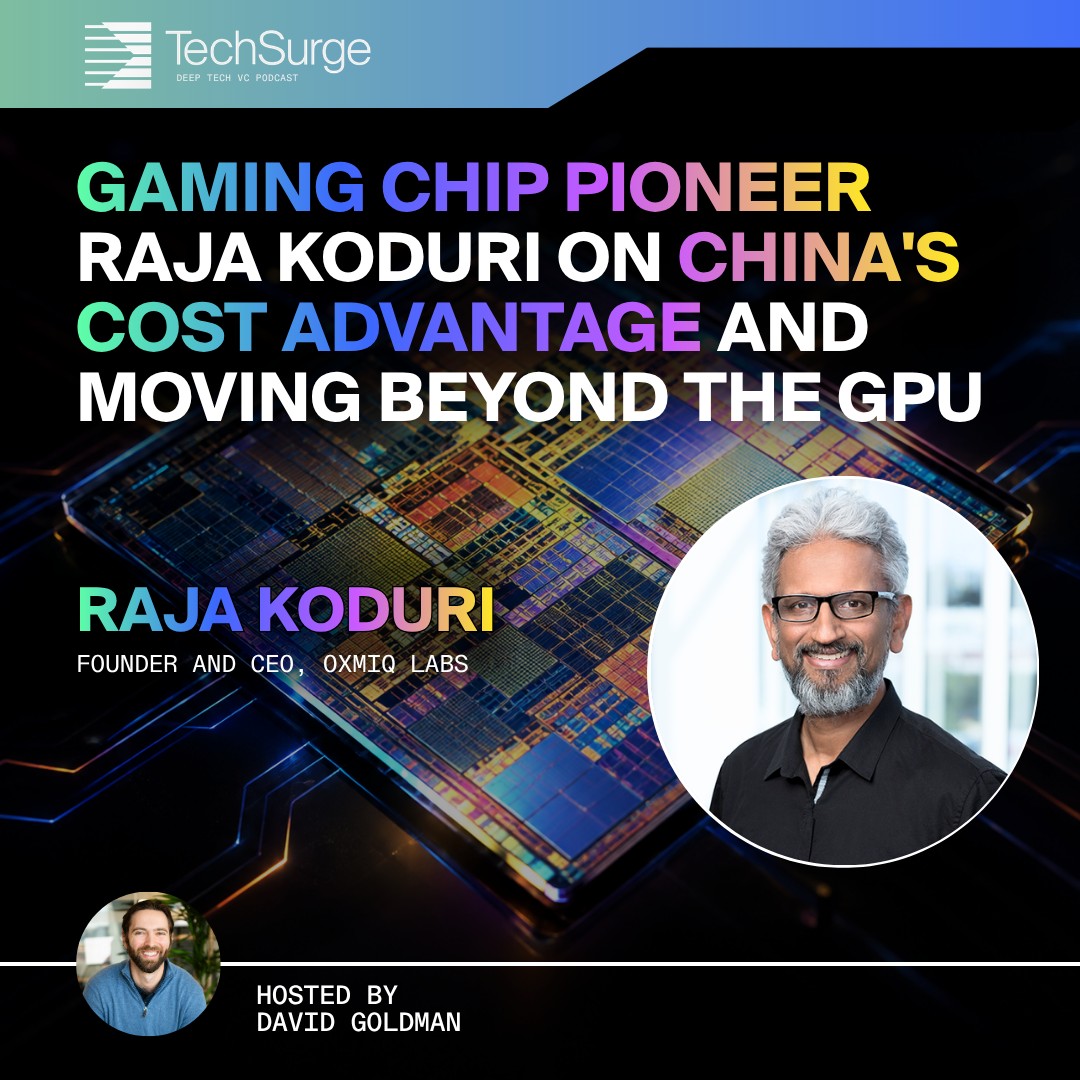
Gaming Chip Pioneer Raja Koduri on China's AI Cost Advantage and Moving Beyond the GPU
Every gigawatt of new AI infrastructure now costs $50 to $60 billion to build, roughly $45 billion of which goes straight into GPUs. With more than 400 gigawatts of new compute needed by 2030, the industry faces a roughly $24 trillion capital bill. But according to this week's guest, the real threat to Western AI competitiveness isn't Nvidia, Google, or Broadcom out-maneuvering one another. It's China Inc., which is targeting a cost of under $10 billion per gigawatt, a five- to six-times cost advantage that could reshape who wins the AI infrastructure race.
In this episode of TechSurge, host David Goldman speaks with Raja Koduri, one of the most influential architects in the history of graphics computing. Raja twice led graphics at AMD, directed graphics architecture at Apple, and served as chief architect of Intel's Core and Visual Computing Group. His team helped bring high bandwidth memory to market for AMD's GPUs back in 2015, a technology that now underpins nearly every AI accelerator on the market.
The conversation centers on Raja's new startup, Oxmiq, which he describes as converting "electrons to tokens super efficiently." Raja and David dig into why the bottleneck in AI infrastructure has quietly shifted away from raw compute and toward memory hierarchy, how data moves between SRAM, HBM, and NAND, and between chips, now that models are too large to fit on a single die. Oxmiq's approach uses 3D-stacked, hybrid-bonded memory to unlock 10x the bandwidth of today's HBM and a 10x increase in token generation rate, even on older process nodes.
From there, the discussion turns to how AI coding agents are changing the economics of chip design. Raja argues that spec-writing, once the "boring" 90 percent of the job, is now the hardest and most valuable skill, while writing the code itself is increasingly something agents can handle. He points to OpenAI and Broadcom's Jalapeño chip as evidence that AI-assisted design can compress timelines that used to take multiple generations of custom silicon. Raja also reflects on lessons from building products alongside Steve Jobs at Apple and Lisa Su at AMD, and explains why he believes Intel's decision to kill 3D XPoint memory came at exactly the wrong moment.
The episode closes with Raja's outlook on where AI infrastructure goes next: a future of both massive "token factories" and smaller, personal "token banks," a shift he compares to the transition offices went through with server rooms, becoming invisible infrastructure that simply works. As he puts it, "the more boring you make it, the more it becomes fabulous."
Sign up for our newsletter at techsurgepodcast.com for updates on upcoming TechSurge Live Summits and future episodes.

In this episode of TechSurge, host Sriram Viswanathan sits down with Nishant Batra, Chief Strategy and Technology Officer at Nokia, for a deep dive into the evolving landscape of telecom and wireless technology. Nishant shares insights into the seismic shifts transforming network infrastructure—from core networks to edge computing—and discusses how Nokia leverages artificial intelligence to optimize performance and drive innovation.
The conversation also highlights Nokia's unique innovation framework, spanning its corporate venture investments, internal incubator, and expansion of the legendary Bell Labs. Today Nokia leverages Bell Labs’ groundbreaking research into emerging technology for internal innovation and new venture spinouts in collaboration with venture capital firms, including recently announced inaugural spinout startup, Astranu.

Competition, growth, tariffs, hacks, AI – what does it take to be an effective leader today? John Chambers, former CEO and Executive Chairman of Cisco and founder of JC2 Ventures, joins TechSurge host Sriram Viswanathan to share valuable wisdom on leading and growing businesses through times of significant change. As a leader who has transitioned from the c-suite to venture capital and now mentoring founders in emerging technology sectors, John has seen it all.
He shares lessons from his time leading one of the world’s most influential networking companies at Cisco (the most valuable company in the world at the time), revealing what he learned while growing it from a challenger networking company into a $50 billion tech powerhouse, sharing how Cisco achieved and maintained its market leadership, particularly his bold M&A strategies.
John offers hard‑won insights on navigating major technology shifts in AI, cloud, security, and more. Today’s founders and executives will find practical frameworks, real‑world war stories, and counterintuitive advice to help survive and thrive in an era of continual disruption.
If you enjoy this episode, please subscribe and leave us a review on your favorite podcast platform. Sign up for our newsletter at techsurgepodcast.com for exclusive insights and updates on upcoming TechSurge Live Summits.

MIT President Emeritus Dr. Rafael Reif joins host Michael Marks for a discussion about the state of U.S. competitiveness in technology, university research funding, current immigration policy, and more. Reif explains why universities remain the innovation engines of economies, educating top talent and generating the foundational research that powers emerging tech and creates new industries. He candidly assesses U.S.-China competition, warns that Chinese research output is rapidly outpacing our own, and urges renewed federal investment.
The discussion explores how restrictive immigration policies threaten the flow of global talent into the U.S and his own impression of current policies as an immigrant from Venezuela himself. As a TSMC board member, Reif also touches on the strategic need for domestic semiconductor fabs, Intel’s path forward, and TSMC’s edge in advancing cutting-edge nodes. Lastly, he addresses gaps in the venture capital funding space and why he created MIT’s The Engine incubator model to fund “tough tech” startups, which helped launch breakthroughs like Commonwealth Fusion Systems.
If you enjoy this episode, please subscribe and leave us a review on your favorite podcast platform. Sign up for our newsletter at techsurgepodcast.com for exclusive insights and updates on upcoming TechSurge Live Summits.

Bobby Yerramilli-Rao, Chief Strategy Officer at Microsoft, joins TechSurge host Sriram Viswanathan to offer a rare glimpse into the strategic playbook of one of the world’s most powerful tech companies. Bobby shares how the company navigates today’s biggest technology paradigm shifts, placing bets with trillion-dollar implications. Touching on Microsoft’s AI strategy, OpenAI partnership, quantum computing, its approach to acquisitions, and much more, this candid and wide-ranging conversation is not to be missed.
If you enjoy this episode, please subscribe and leave us a review on your favorite podcast platform. Sign up for our newsletter at techsurgepodcast.com for exclusive insights and updates on upcoming TechSurge Live Summits.

In this episode of TechSurge, host Sriram Viswanathan sits down with Charlie Giancarlo, Chairman and CEO of Pure Storage, to discuss the evolution and future of data storage in the digital age. Charlie shares insights from his career spanning his pivotal role in Cisco's success as a networking pioneer, to his leadership in transforming Pure Storage into a leader in innovative storage solutions.
They explore the evolution of data center infrastructure, and the critical role of storage architecture in enabling AI and cloud technologies. Charlie also explains how Pure Storage's software-driven approach is creating new efficiencies and opportunities for enterprises, offering a compelling vision for a unified "data cloud" that breaks down data silos and unlocks new insights.
This episode delves into the intersections of networking, compute, storage, and AI, providing an essential perspective for anyone interested in the future of technology infrastructure.
If you enjoy this episode, please subscribe and leave us a review on your favorite podcast platform. Sign up for our newsletter at techsurgepodcast.com for exclusive insights and updates on upcoming TechSurge Live Summits.

Many in venture capital and biopharma are anointing artificial intelligence the savior of drug discovery—but what can AI actually do?
In this eye-opening episode, Michael Marks sits down with Mike Nohaile, CEO of Prellis Biologics, to explore the hype versus reality in AI-enabled drug discovery. Mike details why, despite significant breakthroughs like AlphaFold and recent Nobel Prize win for computational protein design, fully AI-generated medicines still present challenges. He also discusses why we urgently need more effective medicines and details Prellis’ unique system which combines laser printed human organoids and an externalized human immune system with AI, enabling the discovery of fully human antibodies.
If you enjoy this episode, please subscribe and leave us a review on your favorite podcast platform. Sign up for our newsletter at techsurgepodcast.com for exclusive insights and updates on upcoming TechSurge Live Summits.

Celesta Capital is a global deep tech venture firm enabling visionary founders at the forefront of scientific and engineering breakthroughs.
Celesta's team has spent decades founding, leading, and scaling global technology businesses, collectively founding more than 40 companies. We understand how to partner with founders to help turn prototypes into powerhouses.
From semiconductors and systems to breakthrough biology, we seek out the physics‑defying, code‑rewriting breakthroughs that will power the next decade of technology advancement.
Follow on Substack.
