
TechSurge: Deep Tech Podcast
Exploring topics at the intersection of emerging technology, geopolitics, and business.
Hosted by Celesta Capital.


The TechSurge: Deep Tech VC Podcast shares the latest insights directly from legendary Silicon Valley leaders, daring new founders, and visionary technologists.
Join us as we examine the factors shaping the next major technology cycle shift of AI, examine emerging global tech hubs, and analyze where investment dollars are flowing next.
Each discussion delves into the intersection of technology advancement, market dynamics, and the founder journey, offering insights into the vast opportunities and complex challenges ahead.
For entrepreneurs, investors, or anyone interested in where we're headed next, this is your guide to understanding the technologies and companies poised to transform the future.


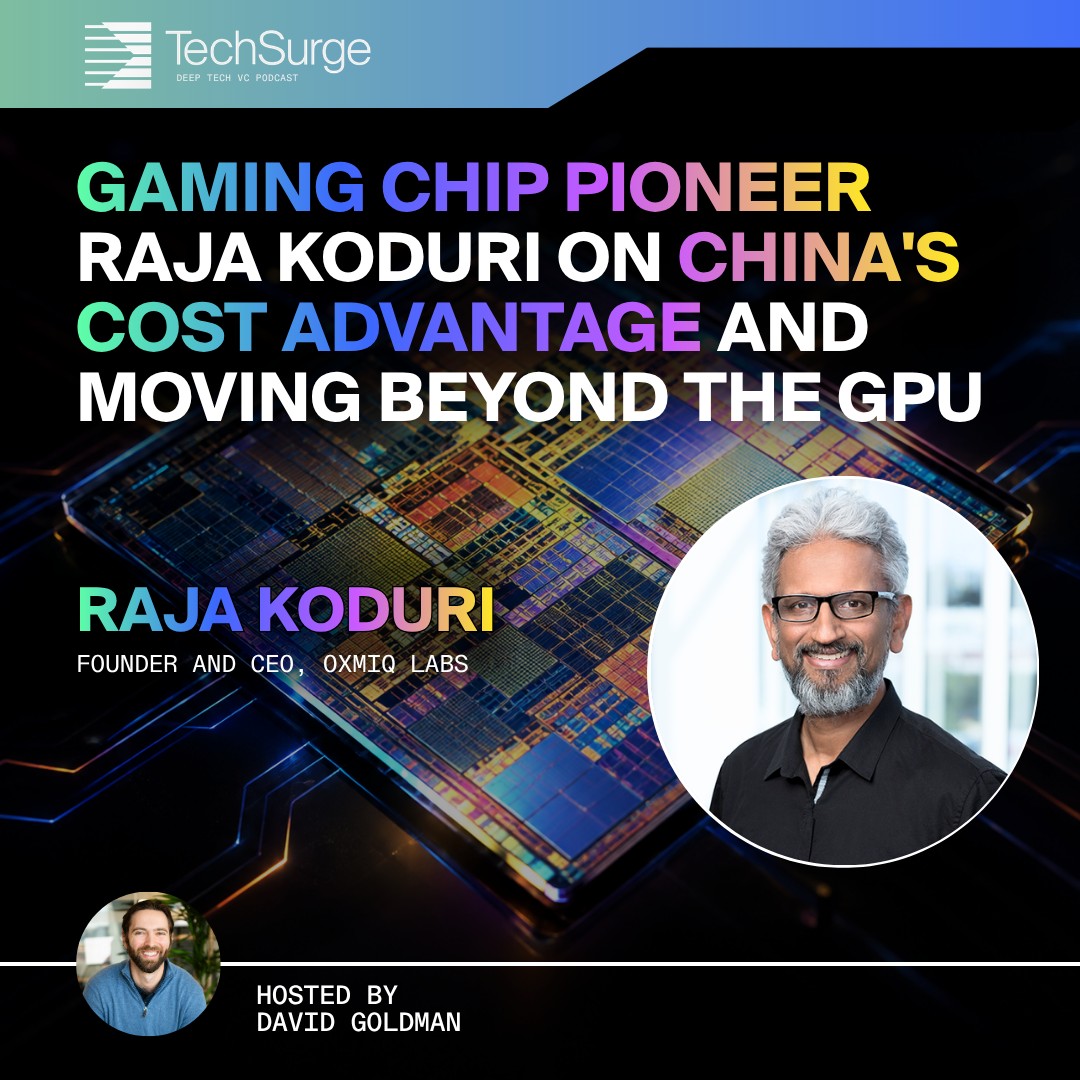
Gaming Chip Pioneer Raja Koduri on China's AI Cost Advantage and Moving Beyond the GPU
Every gigawatt of new AI infrastructure now costs $50 to $60 billion to build, roughly $45 billion of which goes straight into GPUs. With more than 400 gigawatts of new compute needed by 2030, the industry faces a roughly $24 trillion capital bill. But according to this week's guest, the real threat to Western AI competitiveness isn't Nvidia, Google, or Broadcom out-maneuvering one another. It's China Inc., which is targeting a cost of under $10 billion per gigawatt, a five- to six-times cost advantage that could reshape who wins the AI infrastructure race.
In this episode of TechSurge, host David Goldman speaks with Raja Koduri, one of the most influential architects in the history of graphics computing. Raja twice led graphics at AMD, directed graphics architecture at Apple, and served as chief architect of Intel's Core and Visual Computing Group. His team helped bring high bandwidth memory to market for AMD's GPUs back in 2015, a technology that now underpins nearly every AI accelerator on the market.
The conversation centers on Raja's new startup, Oxmiq, which he describes as converting "electrons to tokens super efficiently." Raja and David dig into why the bottleneck in AI infrastructure has quietly shifted away from raw compute and toward memory hierarchy, how data moves between SRAM, HBM, and NAND, and between chips, now that models are too large to fit on a single die. Oxmiq's approach uses 3D-stacked, hybrid-bonded memory to unlock 10x the bandwidth of today's HBM and a 10x increase in token generation rate, even on older process nodes.
From there, the discussion turns to how AI coding agents are changing the economics of chip design. Raja argues that spec-writing, once the "boring" 90 percent of the job, is now the hardest and most valuable skill, while writing the code itself is increasingly something agents can handle. He points to OpenAI and Broadcom's Jalapeño chip as evidence that AI-assisted design can compress timelines that used to take multiple generations of custom silicon. Raja also reflects on lessons from building products alongside Steve Jobs at Apple and Lisa Su at AMD, and explains why he believes Intel's decision to kill 3D XPoint memory came at exactly the wrong moment.
The episode closes with Raja's outlook on where AI infrastructure goes next: a future of both massive "token factories" and smaller, personal "token banks," a shift he compares to the transition offices went through with server rooms, becoming invisible infrastructure that simply works. As he puts it, "the more boring you make it, the more it becomes fabulous."
Sign up for our newsletter at techsurgepodcast.com for updates on upcoming TechSurge Live Summits and future episodes.

Artificial intelligence is evolving at an unprecedented pace—what does that mean for the future of technology, venture capital, business, and even our understanding of ourselves?
Award-winning journalist and writer Anil Ananthaswamy joins us for our latest episode to discuss his latest book Why Machines Learn: The Elegant Math Behind Modern AI.
Anil helps us explore the journey and many breakthroughs that have propelled machine learning from simple perceptrons to the sophisticated algorithms shaping today’s AI revolution, powering GPT and other models. The discussion aims to demystify some of the underlying math that powers modern machine learning to help everyone grasp this technology impacting our lives, even if your last math class was in high school.
Anil walks us through the power of scaling laws, the shift from training to inference optimization, and the debate among AI’s pioneers about the road to AGI—should we be concerned, or are we still missing key pieces of the puzzle? The conversation also delves into AI’s philosophical implications—could understanding how machines learn help us better understand ourselves? And what challenges remain before AI systems can truly operate with agency?
If you enjoy this episode, please subscribe and leave us a review on your favorite podcast platform. Sign up for our newsletter at techsurgepodcast.com for exclusive insights and updates on upcoming TechSurge Live Summits.

With global economic alliances shifting and new threats emerging, will the U.S. maintain its dominance in an increasingly complex world?
From cryptocurrency to chips to cyberterrorist threats, the battle for global dominance is no longer just fought on the battlefield—it’s playing out in markets, boardrooms, and cyberspace. In this episode, we sit down with Juan Zarate, a key member of the post-9/11 Bush Administration team fighting terrorist financing and financial crimes, and an architect of how we view modern financial warfare.
We explore how the U.S. has used its economic dominance as a powerful weapon—and whether countries like China and Russia are now using the same playbook to push back. Juan shares insights on the weaponization of the dollar, how financial crime networks are evolving in the digital age, and why strategies around cryptocurrency could either threaten or reinforce U.S. economic power.
The conversation dives into the intersection of technology, economic, and national security strategy, tackling key issues like cyber threats, semiconductor supply chains, and the growing role of AI in financial security. Juan also introduces his latest venture, Consilient, which is pioneering federated AI to revolutionize the fight against financial crime.

The world is evolving faster than ever – how will we keep up?
From AI breakthroughs to global supply chain disruptions, the forces shaping business and technology today are relentless. In this episode of the TechSurge Deep Tech VC Podcast, we sit down with Bob Sternfels, Global Managing Partner of McKinsey & Company, the global consulting firm who has been on the frontlines of helping businesses and industries navigate relentless change for the past 100 years.
We explore the shifting landscape of venture capital and opportunities for VCs, startups, and consultancies to explore new partnership models. Bob shares his view on shifting global supply chain strategies, why full economic decoupling between the U.S. and China is a dangerous and difficult proposition, and how India may be on track to become the economic powerhouse of the twenty-first century. The discussion digs into the complexities of housing affordability and why the future of housing insurance is at risk – could our homes of the future soon be uninsurable due to climate change?
Bob helps us dive into the evolving demands of 21st-century leadership, where resilience, adaptability, and even humor are becoming essential CEO traits. Bob explains why today’s leaders must rethink their approach to disruption, risk, and innovation – or risk being left behind.
If you enjoy this episode, please subscribe and leave us a review on your favorite podcast platform. Sign up for our newsletter at techsurgepodcast.com for exclusive insights and information about upcoming TechSurge Live Summits.

The future of wireless technology is unfolding, are you ready for what's next?
How can Intel regain market dominance? How will AI and IOT shape the next generation of wireless? What are the challenges in transitioning to 5G, NextG, and beyond? How will academia and the startup world intersect in the 21st century economy?
We explore these questions and more in our latest episode of the TechSurge Deep Tech VC Podcast, as we sit down with Dr. Andrea Goldsmith, Dean of Princeton University’s School of Engineering and Applied Science and a pioneer in wireless communication. Dr. Goldsmith shares insights from her groundbreaking research in multi-antenna systems, the evolution of wireless networks, and the future of cellular technology. We explore her journey as a successful entrepreneur behind Quantenna and Plume WiFi, and her current leadership role as Dean working to build a vibrant engineering and startup ecosystem around Princeton. Dr. Goldsmith also shares her thoughts on the future of Intel, the strategic choices that lie ahead, and its important role within the U.S. tech economy, as well as the broader geopolitical landscape.
Enjoyed this conversation? Subscribe now and leave a review to help us grow! Join our newsletter for exclusive insights and upcoming TechSurge Live Summits at techsurgepodcast.com.

In this episode, host Michael Marks dives into the transformative role of artificial intelligence in healthcare. Michael is joined by Dr. Alex Sardiña of WhiteRabbit.ai and Kalyan Sivasilam of 5C Network, two early adopters bringing AI to medicine through sharply contrasting market models in the U.S. and India, respectively. The discussion unpacks how AI is revolutionizing diagnostics, helping to address labor shortages, and improving patient experiences. Learn about breakthroughs in cancer detection, radiology efficiency, regulatory challenges, and the global potential of AI-driven solutions in medicine.

Host Sriram Viswanathan sits down with Qualcomm Chairman Mark McLaughlin, the former CEO of Palo Alto Networks and Verisign and a trailblazer in technology and cybersecurity. Mark shares his remarkable transition from West Point to the heights of the tech industry, drawing on the many powerful leadership lessons developed throughout his career. Mark shares advice on balancing family priorities and career choices, offering a deeply human perspective on leadership told through his unique experience of stepping down from Palo Alto Networks at the height of his prime as CEO. The discussion touches on the shifting terrain of cybersecurity, the growing influence of AI, and the complexities of board leadership during periods of CEO transition. This episode is packed with practical insights for anyone looking to navigate a c-suite career in tech.

Celesta Capital is a global deep tech venture firm enabling visionary founders at the forefront of scientific and engineering breakthroughs.
Celesta's team has spent decades founding, leading, and scaling global technology businesses, collectively founding more than 40 companies. We understand how to partner with founders to help turn prototypes into powerhouses.
From semiconductors and systems to breakthrough biology, we seek out the physics‑defying, code‑rewriting breakthroughs that will power the next decade of technology advancement.
Follow on Substack.
