
TechSurge: Deep Tech Podcast
Exploring topics at the intersection of emerging technology, geopolitics, and business.
Hosted by Celesta Capital.


The TechSurge: Deep Tech VC Podcast shares the latest insights directly from legendary Silicon Valley leaders, daring new founders, and visionary technologists.
Join us as we examine the factors shaping the next major technology cycle shift of AI, examine emerging global tech hubs, and analyze where investment dollars are flowing next.
Each discussion delves into the intersection of technology advancement, market dynamics, and the founder journey, offering insights into the vast opportunities and complex challenges ahead.
For entrepreneurs, investors, or anyone interested in where we're headed next, this is your guide to understanding the technologies and companies poised to transform the future.


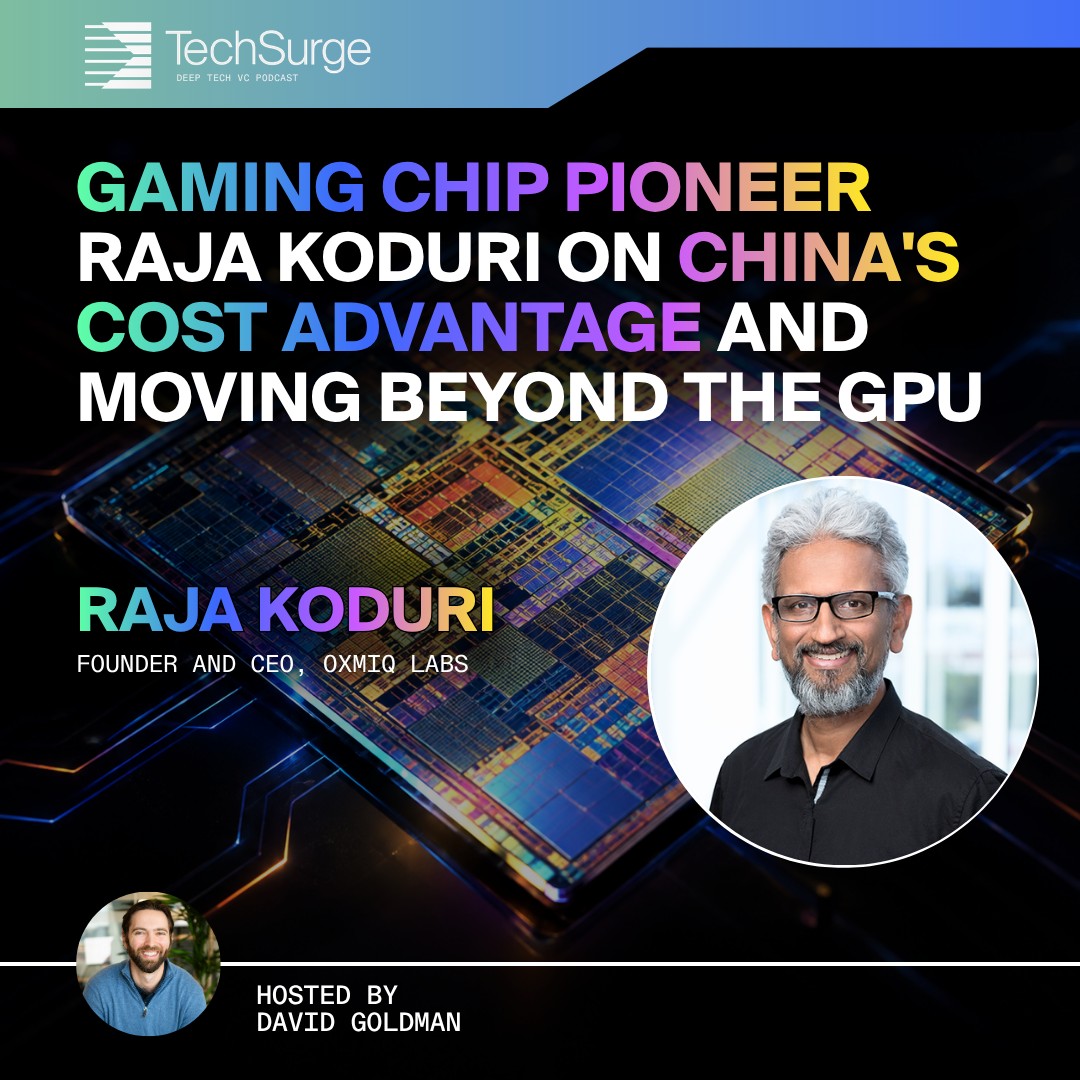
Gaming Chip Pioneer Raja Koduri on China's AI Cost Advantage and Moving Beyond the GPU
Every gigawatt of new AI infrastructure now costs $50 to $60 billion to build, roughly $45 billion of which goes straight into GPUs. With more than 400 gigawatts of new compute needed by 2030, the industry faces a roughly $24 trillion capital bill. But according to this week's guest, the real threat to Western AI competitiveness isn't Nvidia, Google, or Broadcom out-maneuvering one another. It's China Inc., which is targeting a cost of under $10 billion per gigawatt, a five- to six-times cost advantage that could reshape who wins the AI infrastructure race.
In this episode of TechSurge, host David Goldman speaks with Raja Koduri, one of the most influential architects in the history of graphics computing. Raja twice led graphics at AMD, directed graphics architecture at Apple, and served as chief architect of Intel's Core and Visual Computing Group. His team helped bring high bandwidth memory to market for AMD's GPUs back in 2015, a technology that now underpins nearly every AI accelerator on the market.
The conversation centers on Raja's new startup, Oxmiq, which he describes as converting "electrons to tokens super efficiently." Raja and David dig into why the bottleneck in AI infrastructure has quietly shifted away from raw compute and toward memory hierarchy, how data moves between SRAM, HBM, and NAND, and between chips, now that models are too large to fit on a single die. Oxmiq's approach uses 3D-stacked, hybrid-bonded memory to unlock 10x the bandwidth of today's HBM and a 10x increase in token generation rate, even on older process nodes.
From there, the discussion turns to how AI coding agents are changing the economics of chip design. Raja argues that spec-writing, once the "boring" 90 percent of the job, is now the hardest and most valuable skill, while writing the code itself is increasingly something agents can handle. He points to OpenAI and Broadcom's Jalapeño chip as evidence that AI-assisted design can compress timelines that used to take multiple generations of custom silicon. Raja also reflects on lessons from building products alongside Steve Jobs at Apple and Lisa Su at AMD, and explains why he believes Intel's decision to kill 3D XPoint memory came at exactly the wrong moment.
The episode closes with Raja's outlook on where AI infrastructure goes next: a future of both massive "token factories" and smaller, personal "token banks," a shift he compares to the transition offices went through with server rooms, becoming invisible infrastructure that simply works. As he puts it, "the more boring you make it, the more it becomes fabulous."
Sign up for our newsletter at techsurgepodcast.com for updates on upcoming TechSurge Live Summits and future episodes.

Micron CEO Sanjay Mehrotra discusses his journey in the semiconductor industry and the growing strategic importance of the memory industry in the age of AI. He highlights innovation in high bandwidth memory (HBM), which enables faster data access and lower power consumption. Sanjay also discusses Micron’s plans to build new U.S. semiconductor factories and the role of the CHIPS Act in bringing semiconductor manufacturing back to the U.S. He shares his insights on the resurgence of hardware innovation and what it takes to drive technological leadership in a rapidly evolving industry.

Former CEO of PepsiCo and New York Times bestselling author Indra Nooyi joins host Michael Marks for a wide-ranging conversation to share her insights on the growth of big tech companies, the impact of AI, CEO-board relationships, and much more.
Indra currently serves on the boards of Amazon, Phillips, Memorial Sloan Kettering Cancer Center, the National Gallery of Art, and is a Dean’s Advisory Council Member at MIT School of Engineering. Her New York Times bestselling memoir My Life In Full offers insight and a call-to-action from one of the world’s most-admired business leaders on how our society can blend work and family — and advance women — in the 21st century. She is widely considered to be one of the world’s top CEOs for her leadership at global giant PepsiCo over 12 years.

Driven both by surging demand and rapid technology advancements, an emerging area of health innovation called “bioconvergence” is driving improvements in human health and sustained interest from investors. This episode will explore these new applications merging engineered technologies with scientific disciplines, including in diagnostics, therapeutics, and elsewhere.
Nobel Laureate Dr. Jim Rothman, Dr. Melanie Mathieu of Prellis Biologics, and Daniel Dornbusch of Excision join host Michael Marks for an in-depth discussion covering advancements in CRISPR technology, the role of AI in drug discovery, the future of personalized medicine, and much more.

Legendary technology founder and venture investor Vinod Khosla joins host Michael Marks for a wide-ranging discussion on the future of AI, major tech cycles, the importance of being honest with founders, and much more. Vinod shares his predictions for the next 25 years of technology advancement and how we should be assessing the risks and benefits as the adoption of artificial intelligence continues to accelerate.

Celesta Capital is a global deep tech venture firm enabling visionary founders at the forefront of scientific and engineering breakthroughs.
Celesta's team has spent decades founding, leading, and scaling global technology businesses, collectively founding more than 40 companies. We understand how to partner with founders to help turn prototypes into powerhouses.
From semiconductors and systems to breakthrough biology, we seek out the physics‑defying, code‑rewriting breakthroughs that will power the next decade of technology advancement.
Follow on Substack.
