
Intel CEO Lip-Bu Tan on 40 Years of Contrarian Bets in Semiconductors
August 11, 2026
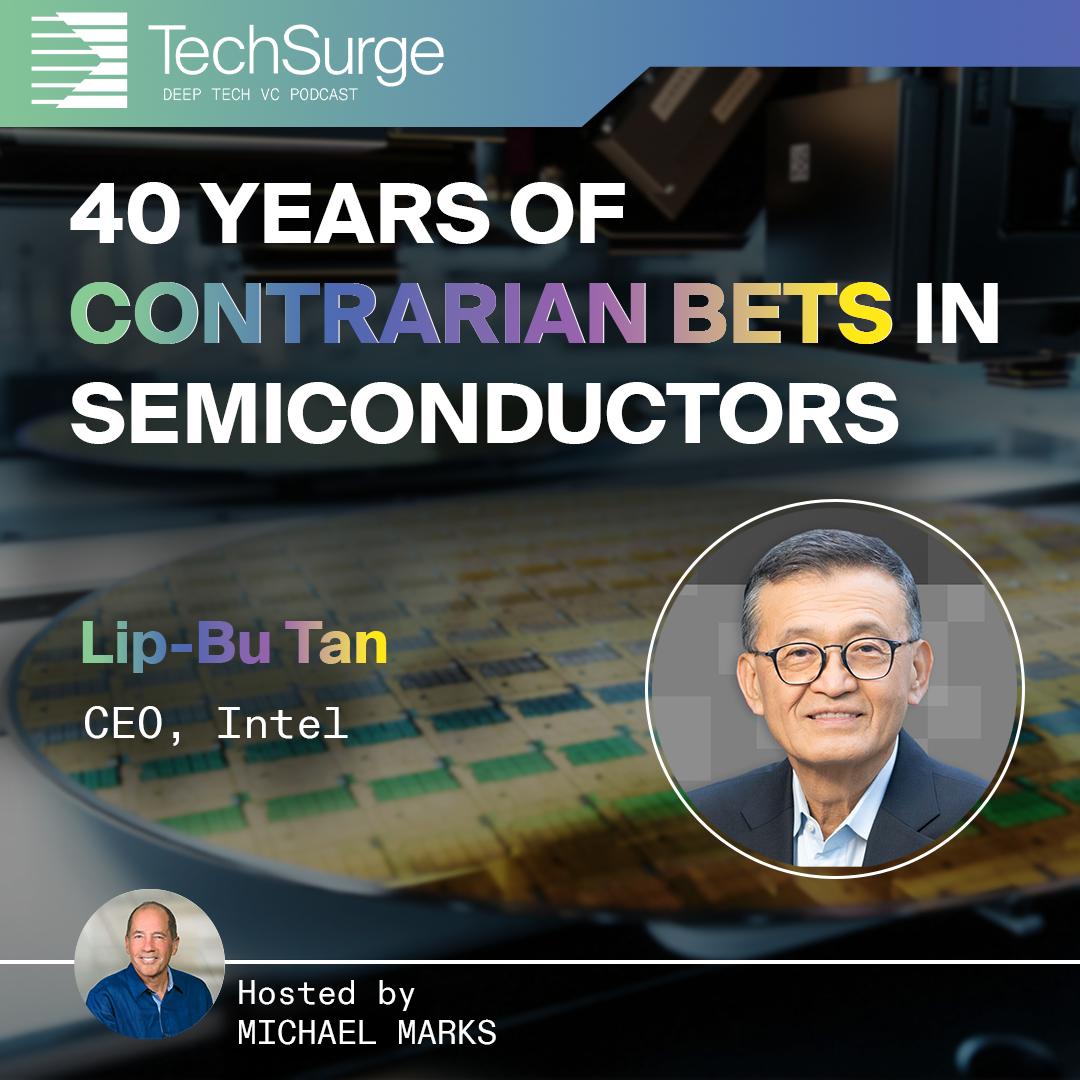
Silicon Valley was built on semiconductors, but for nearly two decades, venture capital shifted its attention towards software. Today, AI is changing that as the demand for compute, memory and networking explodes, hardware is once again at the centre of the industry's biggest bets.
In this episode of TechSurge, host Michael Marks speaks with Lip-Bu Tan, CEO of Intel and one of the semiconductor industry's most influential investors and executives. The conversation traces Tan's journey from studying nuclear engineering at MIT to leading Cadence's turnaround, investing in more than 500 technology companies, and now steering Intel through one of the most significant transformations in its history.
Tan shares his VC conviction on backing semiconductor startups when most venture investors favored software, and why he believes AI's next breakthroughs will come from advances in memory, packaging, photonics, cooling and high-speed connectivity. He also opens up on the leadership philosophy that defined his time at Cadence, where listening to customers and building a culture of responsiveness became the foundation of the company's revival.
Wearing his CEO hat, Tan explains Intel's long-term strategy, why vertical integration still matters, how the company plans to reconnect with the startup ecosystem, and why missing another technology wave is not an option.
Sign up for our newsletter at techsurgepodcast.com for updates on upcoming TechSurge Live Summits and future episodes.


Speaker Profiles and Links
Lip-Bu Tan: CEO of Intel Corporation, Chairman of Walden International, Founding Managing Partner of Walden Catalyst Ventures
LinkedIn: https://www.linkedin.com/in/lip-bu-tan-284a7846/
Further reading and resources
- Reuters – “Intel’s new CEO plots overhaul of manufacturing and AI operations” https://www.reuters.com/technology/intels-new-ceo-plots-overhaul-manufacturing-ai-operations-2025-03-17/
- Intel – https://www.intel.com
- Celesta Capital – https://www.celesta.vc
- SIA – “Global annual semiconductor sales increase 25.6% to $791.7 billion in 2025” – https://www.semiconductors.org/global-annual-semiconductor-sales-increase-25-6-to-791-7-billion-in-2025/
- Infercom – “What is an RDU? Reconfigurable Dataflow Unit” – https://infercom.ai/glossary/rdu/
- SemiconductorX – “Advanced Packaging: CoWoS, Foveros, EMIB, 3D IC” – https://semiconductorx.com/packaging-overview.html
- TWIML AI Podcast – “Dataflow Computing for AI Inference [Kunle Olukotun]” – https://twimlai.com/go/751
Chapters:
00:00- Introduction
03:03- Lip-Bu Tan's Journey to Silicon Valley
04:12- Betting on Semiconductors Before AI
06:25- Why Hardware Matters Again
07:35- Investing in Deep Tech
09:31- Learning Through Boardrooms
12:10- Building the Next Generation of AI Infrastructure
17:03- The Cadence Turnaround
19:03- Customer Obsession as a Leadership Strategy
23:02- Rebuilding Intel
26:03- AI's Next Bottlenecks
30:32- Looking Ahead: The Future of Computing

FedEx CEO on Physical AI, the Big Bet on Data, and the Two Trillion-Dollar Supply Chain Problem
Before 2020, few people thought about supply chains. Now they’re on every boardroom agenda, and few companies have a better view into what changed than FedEx.
Host Michael Marks talks with Raj Subramaniam, only the second CEO in FedEx’s history after founder Fred Smith, about why he calls today’s trade shift “re-globalization,” how the 2025 end of de minimis forced FedEx to hire 2,000 people in three weeks, and why Amazon is a customer rather than a competitor.
They dig into how FedEx turns two petabytes of daily data into predictive logistics, the company’s growing use of physical AI, from trailer-loading robots to autonomous trucks nearing a million miles in Texas, and why Raj insists AI is adding jobs at FedEx, not cutting them.
Sign up for our newsletter at techsurgepodcast.com for updates on upcoming TechSurge Live Summits and future episodes.
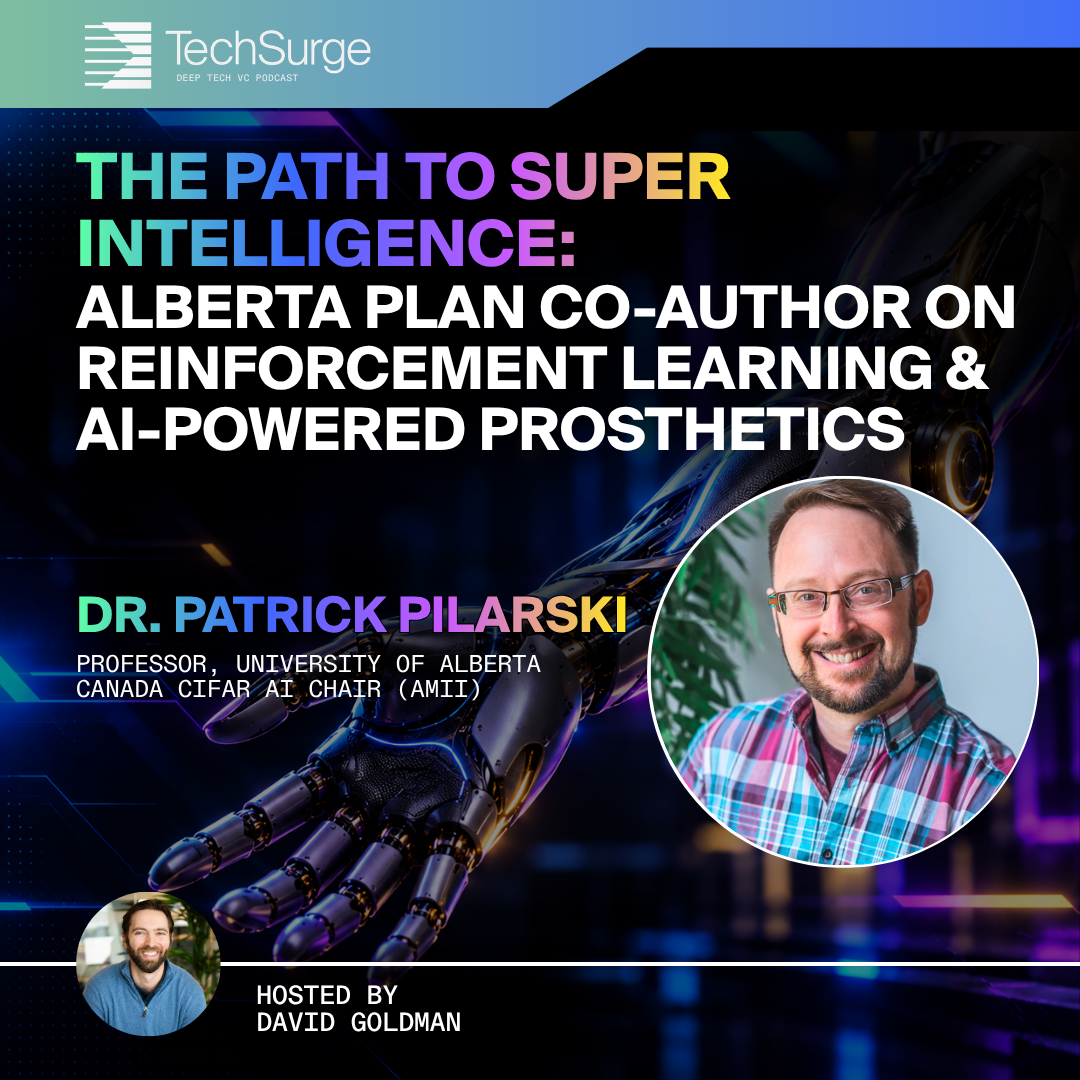
Patrick Pilarski: Alberta Plan Co-Author On Reinforcement Learning & AI-Powered Prosthetics
For all the competition among AI labs, their primary products are built in much the same way: a large language model is pre-trained on enormous datasets, post-trained, deployed, and refreshed every so often. In 2022, three researchers in Alberta, Canada published a contrarian roadmap for AI that rejects that entire premise.
In this episode of TechSurge, host David Goldman speaks with Patrick Pilarski, who co-wrote the Alberta Plan with Richard Sutton and Michael Bowling. Pilarski is a Canada CIFAR AI Chair, an Amii Fellow, and a professor in the Department of Medicine at the University of Alberta, where his lab builds prosthetic limbs that learn to anticipate what their users intend. In 2017, he was one of three Amii researchers who brought DeepMind’s first international research office to Edmonton, serving as its co-lead until 2023.
The conversation opens with the Alberta Plan’s core premise: an agent that constructs all of its knowledge from its own stream of experience, with no artificial separation between training and deployment, what Pilarski calls “temporal uniformity.” He contrasts this with how today’s major AI labs bolt reinforcement learning onto pre-trained language models during post-training, and addresses head-on why his co-author Rich Sutton has publicly argued that LLMs are a dead end.
Pilarski also breaks news on the podcast: he will soon join ExperienceFlow.AI, a San Francisco-based company with a research lab led scientifically by Richard Sutton, as Head of Edge Superintelligence, focused on bringing continual learning to computing environments where connectivity and compute are limited. He argues that the industry’s massive data center build-out does not lock AI into a single architectural path, and that existing hardware and software stacks have far more flexibility than commonly assumed.
The episode closes with a tour through Pilarski’s own research: how AI-powered prosthetic limbs learn to predict user intent in minutes rather than months, a landmark bone-anchored prosthetic surgery performed in Alberta, and the prospect of supernumerary limbs and wearable technology as a path toward genuine human augmentation. Pilarski also discusses a paper he co-authored arguing that AI agent safety concerns dominating recent headlines are, in fact, reinforcement learning problems the field has studied for decades.
Sign up for our newsletter at techsurgepodcast.com for updates on upcoming TechSurge Live Summits and future episodes.

Gaming Chip Pioneer Raja Koduri on China's AI Cost Advantage and Moving Beyond the GPU
Every gigawatt of new AI infrastructure now costs $50 to $60 billion to build, roughly $45 billion of which goes straight into GPUs. With more than 400 gigawatts of new compute needed by 2030, the industry faces a roughly $24 trillion capital bill. But according to this week's guest, the real threat to Western AI competitiveness isn't Nvidia, Google, or Broadcom out-maneuvering one another. It's China Inc., which is targeting a cost of under $10 billion per gigawatt, a five- to six-times cost advantage that could reshape who wins the AI infrastructure race.
In this episode of TechSurge, host David Goldman speaks with Raja Koduri, one of the most influential architects in the history of graphics computing. Raja twice led graphics at AMD, directed graphics architecture at Apple, and served as chief architect of Intel's Core and Visual Computing Group. His team helped bring high bandwidth memory to market for AMD's GPUs back in 2015, a technology that now underpins nearly every AI accelerator on the market.
The conversation centers on Raja's new startup, Oxmiq, which he describes as converting "electrons to tokens super efficiently." Raja and David dig into why the bottleneck in AI infrastructure has quietly shifted away from raw compute and toward memory hierarchy, how data moves between SRAM, HBM, and NAND, and between chips, now that models are too large to fit on a single die. Oxmiq's approach uses 3D-stacked, hybrid-bonded memory to unlock 10x the bandwidth of today's HBM and a 10x increase in token generation rate, even on older process nodes.
From there, the discussion turns to how AI coding agents are changing the economics of chip design. Raja argues that spec-writing, once the "boring" 90 percent of the job, is now the hardest and most valuable skill, while writing the code itself is increasingly something agents can handle. He points to OpenAI and Broadcom's Jalapeño chip as evidence that AI-assisted design can compress timelines that used to take multiple generations of custom silicon. Raja also reflects on lessons from building products alongside Steve Jobs at Apple and Lisa Su at AMD, and explains why he believes Intel's decision to kill 3D XPoint memory came at exactly the wrong moment.
The episode closes with Raja's outlook on where AI infrastructure goes next: a future of both massive "token factories" and smaller, personal "token banks," a shift he compares to the transition offices went through with server rooms, becoming invisible infrastructure that simply works. As he puts it, "the more boring you make it, the more it becomes fabulous."
Sign up for our newsletter at techsurgepodcast.com for updates on upcoming TechSurge Live Summits and future episodes.