
Sovereign AI Stacks: The New Strategic National Resource
March 19, 2026
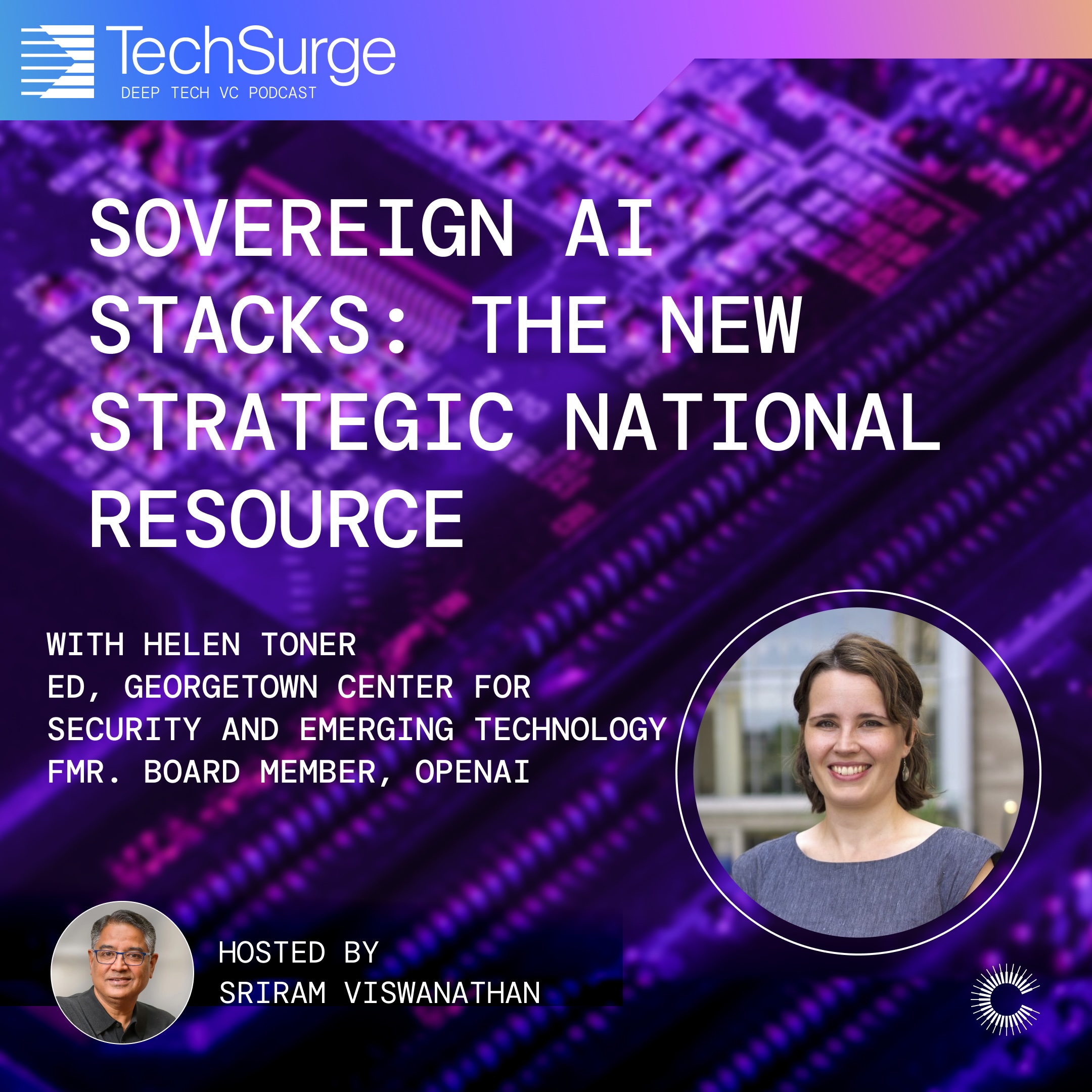
As artificial intelligence becomes a strategic capability for nations as well as companies, questions of governance, safety, and geopolitical competition are moving to the forefront. In this episode of TechSurge, host Sriram Viswanathan speaks with Helen Toner, Interim Executive Director of the Center for Security and Emerging Technology (CSET) at Georgetown and a former OpenAI board member, about the rise of sovereign AI stacks and the global implications of increasingly powerful AI systems.
Helen brings a rare vantage point from both inside the frontier AI ecosystem and the policy world. She reflects on lessons from her time on the OpenAI board, including the governance challenges that arise when nonprofit missions intersect with enormous commercial incentives and rapid technological progress. As AI capabilities accelerate, she argues that the industry is still grappling with deep uncertainty about how these systems work, how they will evolve, and what responsibilities companies and governments should carry.
The conversation explores the idea of sovereign AI; the growing push by countries to control key layers of the AI stack, including compute infrastructure, models, and data. Helen explains why governments increasingly view AI as a strategic national resource, comparable to past transformative technologies like electricity or the internet. At the same time, she cautions that full technological independence may be unrealistic for most nations, given the complexity and global interdependence of the AI supply chain.
Sriram and Helen also examine the evolving US–China AI competition, the role of export controls and semiconductor supply chains, and how different countries, from China to emerging AI hubs in the Middle East, are positioning themselves in the race to build advanced AI capabilities. Along the way, they discuss whether the industry should slow down development, how companies are experimenting with “safety frameworks” for frontier models, and why installing guardrails may be more realistic than attempting to halt progress altogether.
Ultimately, Helen argues that society is entering a period of profound uncertainty. AI is transitioning from a research discipline into a foundational system that will shape economies, security, and daily life. Navigating that transition will require not just technical breakthroughs, but new approaches to governance, transparency, and global cooperation.
If you enjoy this episode, please subscribe and leave us a review on your favorite podcast platform.
Sign up for our newsletter at techsurgepodcast.com for updates on upcoming TechSurge Live Summits and future Season 2 episodes.


Chapters
03:00 Lessons from the OpenAI Board: Governance in the Age of Frontier AI
05:00 The Big Unknowns in AI Development: Why Experts Still Disagree
12:05 Public Trust and the Risk of an AI Backlash
14:20 When AI Became Infrastructure: From Research Field to Societal System
16:00 Is AGI a Meaningless Term Now? Rethinking the Goalposts
19:05 AI’s True Scale: Internet-Level Impact or Something Bigger?
23:15 Why Frontier AI Labs Struggle to Slow Down
24:40 What “Sovereign AI” Actually Means for Nations
28:10 Mapping the AI Stack: Chips, Cloud, Models, and Applications
33:38 The US–China AI Competition: Who’s Ahead and Why
39:44 China’s Progress in AI: Compute Constraints and Fast Followers
44:03 US AI Policy: Export Controls, Regulation, and Federal Preemption
48:40 Frontier AI Safety Frameworks: How Labs Define Dangerous Capabilities
51:36 The Future of AI: Utopia, Industrialization, or Something Worse?
56:04 Rapid Fire: AI Misconceptions, Governance Reforms, and Regions to Watch
Episode Links
Connect with Helen: linkedin.com/in/helen-toner-4162439a
Learn more about CSET: https://cset.georgetown.edu/
.png)
The Nobel Winner Who Built Google's Quantum Computer: Why I'm Building NVIDIA of Quantum
In this episode, Nobel Prize-winning physicist Dr. John Martinis reveals how his breakthrough in superconducting qubits made quantum physics real at macroscopic scale and what it means for the future of technology. The former lead of Google's Quantum AI lab explains why quantum computing is so fragile, why a lot of hype has a low chance to work, and why his fabless company Qolab could be the Nvidia of quantum computing.
In this conversation, Dr. Martinis joins Tech Surge to explain the science behind macroscopic quantum coherence, the engineering challenges of scaling quantum computers, and how hybrid quantum-classical computing will shape the future of technology.
The conversation covers:
✅ How the superconducting qubit breakthrough won the Nobel Prize in Physics
✅ Why Nature wants to destroy quantum coherence and why quantum is fragile
✅ From academic physics to building Google's quantum computer
✅ The engineering challenge of scaling quantum computing beyond the lab
✅ Why a lot of quantum computing hype has a low chance to work
✅ How Qolab's fabless model could scale quantum hardware
Sign up for our newsletter at techsurgepodcast.com for updates on upcoming TechSurge Live Summits and future episodes.
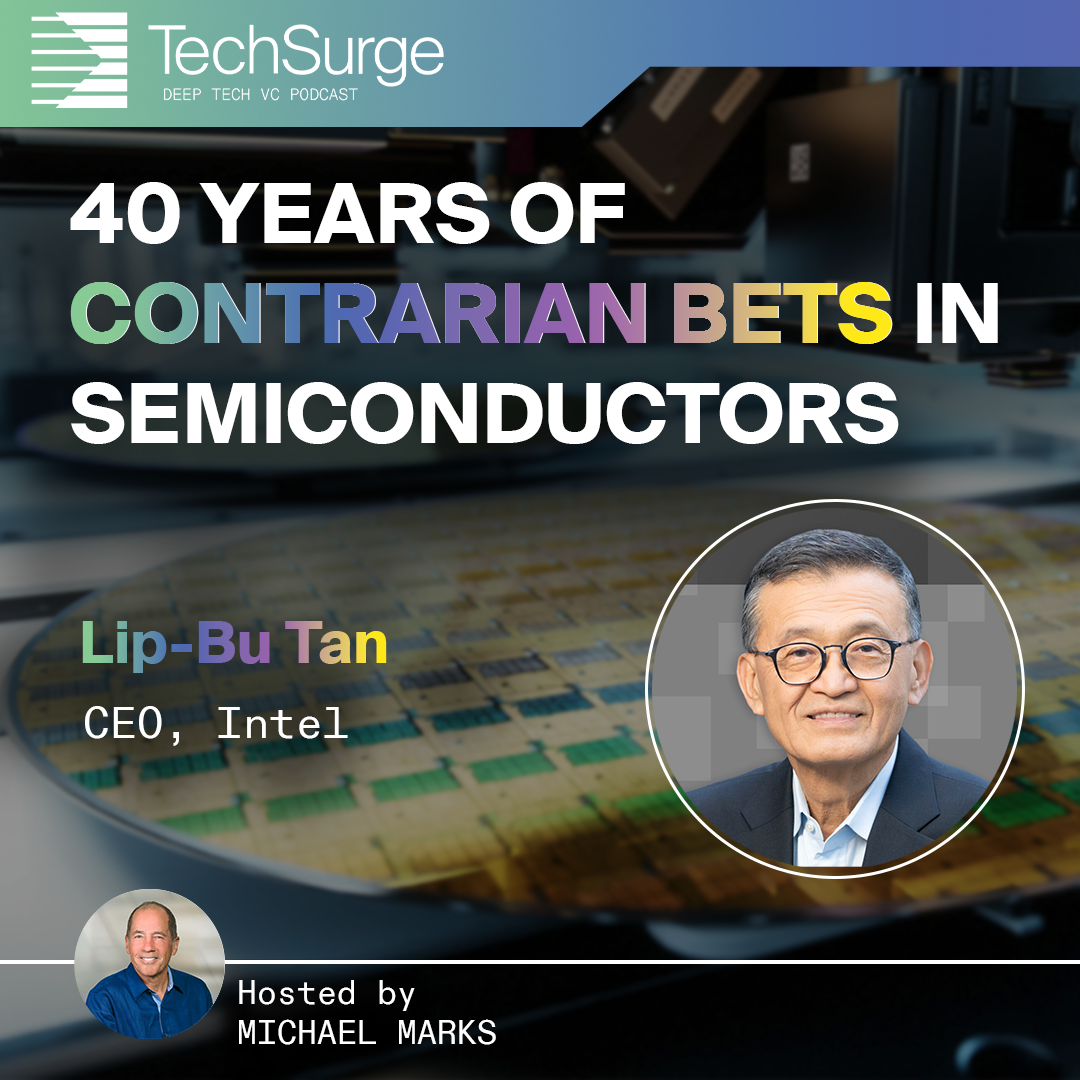
Intel CEO Lip-Bu Tan on 40 Years of Contrarian Bets in Semiconductors
Silicon Valley was built on semiconductors, but for nearly two decades, venture capital shifted its attention towards software. Today, AI is changing that as the demand for compute, memory and networking explodes, hardware is once again at the centre of the industry's biggest bets.
In this episode of TechSurge, host Michael Marks speaks with Lip-Bu Tan, CEO of Intel and one of the semiconductor industry's most influential investors and executives. The conversation traces Tan's journey from studying nuclear engineering at MIT to leading Cadence's turnaround, investing in more than 500 technology companies, and now steering Intel through one of the most significant transformations in its history.
Tan shares his VC conviction on backing semiconductor startups when most venture investors favored software, and why he believes AI's next breakthroughs will come from advances in memory, packaging, photonics, cooling and high-speed connectivity. He also opens up on the leadership philosophy that defined his time at Cadence, where listening to customers and building a culture of responsiveness became the foundation of the company's revival.
Wearing his CEO hat, Tan explains Intel's long-term strategy, why vertical integration still matters, how the company plans to reconnect with the startup ecosystem, and why missing another technology wave is not an option.
Sign up for our newsletter at techsurgepodcast.com for updates on upcoming TechSurge Live Summits and future episodes.

The Moving Bottleneck: Networking, Power, Memory, and the Race to Win AI
Artificial intelligence is often discussed through models and GPUs. This episode looks beneath that surface, at the power delivery and networking required to make AI work at scale.
Host Sriram Viswanathan speaks with Rajiv Khemani, a serial deep tech entrepreneur whose career has tracked several major infrastructure cycles: internet networking, cloud switching, blockchain compute and now AI networking. Khemani reflects on his early work at NetBoost and Intel, his operating role at Cavium, and the founding of Innovium, which Marvell agreed to acquire for $1.1 billion in 2021. He also explains how work on low-power blockchain silicon led his team toward the infrastructure demands created by generative AI.
The discussion examines why incumbents often overlook emerging markets, why purpose-built hardware can outperform systems inherited from an earlier technology cycle, and how founders decide whether to keep financing a company or sell while the outcome remains attractive. Khemani describes the concentration risk of selling to a small number of hyperscalers, the fragility of semiconductor supply chains, and why leading-edge chip development now demands much larger balance sheets.
The conversation then turns to AI’s emerging bottlenecks. Large models require many accelerators to operate as one computer, making low-latency scale-up and scale-out networks central to performance. The episode explores heterogeneous compute, open networking standards, memory scarcity, AI’s growing electricity demand, and the competition between AI and Bitcoin mining for energy.
Sign up for our newsletter at techsurgepodcast.com for updates on upcoming TechSurge Live Summits and future episodes.