
TechSurge: Deep Tech Podcast
Exploring topics at the intersection of emerging technology, geopolitics, and business.
Hosted by Celesta Capital.


The TechSurge: Deep Tech VC Podcast shares the latest insights directly from legendary Silicon Valley leaders, daring new founders, and visionary technologists.
Join us as we examine the factors shaping the next major technology cycle shift of AI, examine emerging global tech hubs, and analyze where investment dollars are flowing next.
Each discussion delves into the intersection of technology advancement, market dynamics, and the founder journey, offering insights into the vast opportunities and complex challenges ahead.
For entrepreneurs, investors, or anyone interested in where we're headed next, this is your guide to understanding the technologies and companies poised to transform the future.


.png)
The Race to Build the Next Trillion-Dollar AI Chip Company
Almost 2% of U.S. GDP will be spent on AI infrastructure this year, nearly double 2025's figure. But beneath those headline numbers, the composition of that spending has quietly flipped: for the first time, dollars spent on running models in production now outweigh dollars spent training them.
In this episode of TechSurge, host David Goldman speaks with Austin Lyons, a semiconductor analyst at Creative Strategies, co-host of the Semi Doped podcast, and author of the Chipstrat newsletter. Lyons previously worked as a hardware engineer at Intel and as a product manager on John Deere's autonomous tractor and Blue River Technology teams before turning to full-time chip industry analysis.
The conversation opens with why AI buyers have moved from assembling commoditized parts to buying entire pre-integrated systems, tracing how Nvidia's rack-scale approach, exemplified by its 72-GPU Grace Blackwell racks, made turnkey deployment the default, and why that raises the bar for any chip startup trying to compete. Lyons and Goldman then unpack how inference workloads have split into two distinct problems, prefill and decode, and how that split created an opening for SRAM-based challengers to outperform general-purpose GPUs on decode speed.
From there, the discussion turns to the rise of neoclouds, the GPU-rental companies that grew into public businesses worth well over $100 billion combined, and why so many traditional investors missed them. Lyons and Goldman work through the circular financing debate head-on: the mechanics of Nvidia's equity stakes, GPU-backed debt, and hyperscaler off-take agreements that critics compare to dot-com-era vendor financing, and the counterargument that demand is simply outrunning fixed supply.
The episode closes on Lyons's own framework for identifying the next trillion-dollar chip company, built on four conditions including the ability to run trillion-parameter models at rack scale, beat an incumbent on a key performance metric, and land a frontier anchor customer, along with a look at how AI-assisted chip design is lowering the barrier for more companies, from OpenAI to electric vehicle makers, to design their own custom silicon.
Sign up for our newsletter at techsurgepodcast.com for updates on upcoming TechSurge Live Summits and future episodes.
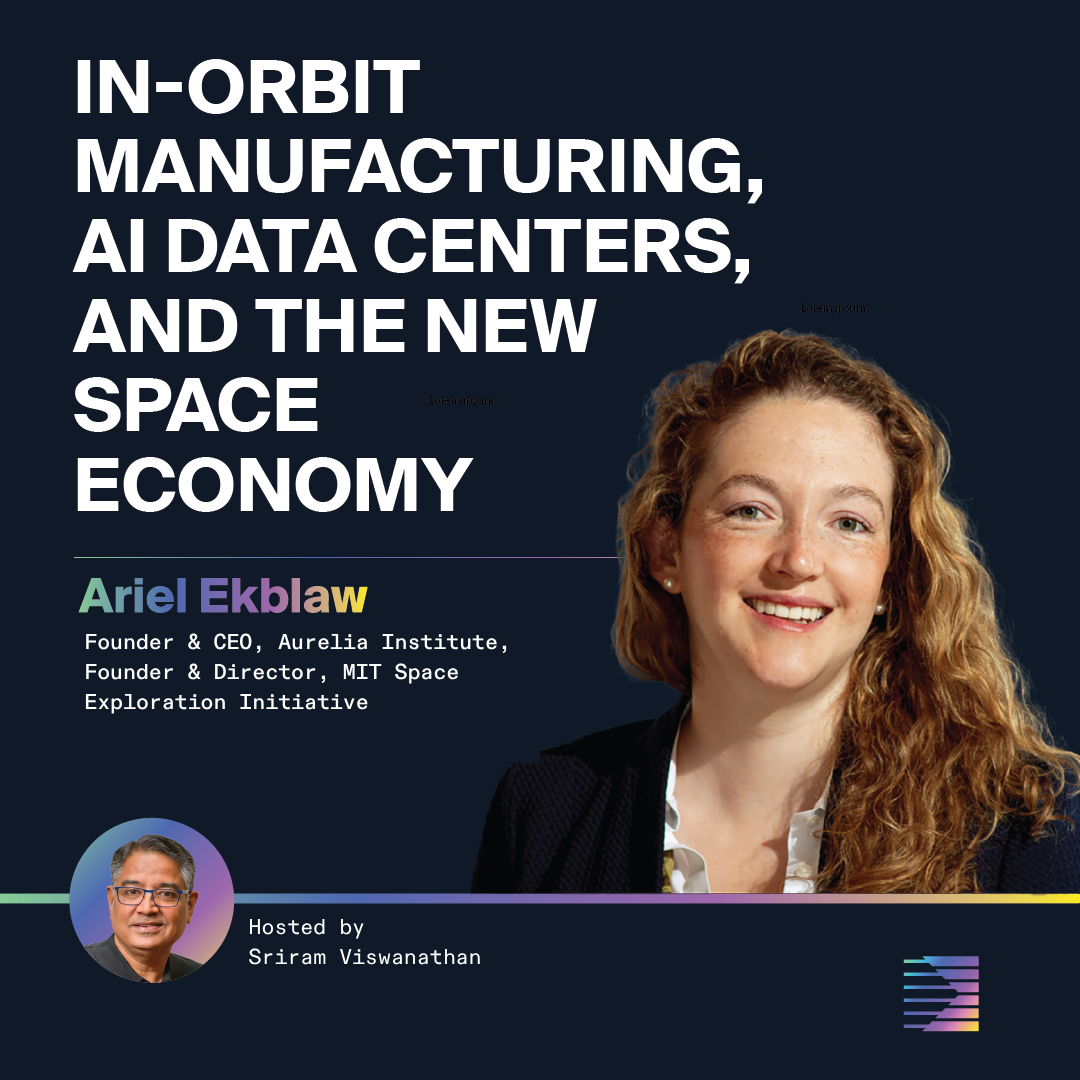
For most of human history, space has been a place we visited. The next chapter may be about building there.
For decades, space was the domain of governments, astronauts, and science fiction. Today, falling launch costs, reusable rockets, and a new generation of ambitious founders are turning orbit into something else entirely: a place to build. The question is no longer whether humanity can construct large-scale infrastructure in space, but what we should build first-and why.
In this episode of TechSurge, host Sriram Vishwanath speaks with Dr. Ariel Ekblaw, Founder and CEO of Aurelia Institute, Research Affiliate at MIT’s Space Exploration Initiative, and founder of Rendezvous Robotics. Ariel has spent her career exploring one of the most fundamental challenges of the emerging space economy: how to build structures in orbit that are far larger than anything that can fit inside a rocket.
Ariel explains the origins of TESSERAE, her pioneering work on autonomous self-assembling space architecture, and how ideas borrowed from biology, swarm intelligence, and modular construction could unlock a future of massive solar arrays, communications infrastructure, orbital laboratories, and eventually human habitats in space.
The conversation explores the rapidly emerging market for in-orbit infrastructure, including AI data centers in space, space-based solar power, and the technologies needed to support a permanent industrial presence beyond Earth. Ariel breaks down the engineering realities behind these ideas—why cooling data centers in space is harder than most people assume, how autonomous assembly could solve the scale problem, and why the future of orbital infrastructure may look more like a business park than a collection of standalone satellites.
Sriram and Ariel also discuss the broader implications of humanity’s return to space: the economics unlocked by reusable launch systems, the opportunities created by dramatically lower transportation costs, and the second-order innovations that may emerge from building an industrial ecosystem in orbit. Along the way, they examine space debris, stewardship of the orbital commons, artificial gravity, and what it will take to make long-term human habitation in space viable.
At the heart of the discussion is Ariel’s belief that space is not an escape from Earth’s problems, but a tool for solving them. Whether through advanced manufacturing, new energy systems, biotechnology research, or entirely new industries, she argues that the next era of space exploration should be focused on improving life here at home.
Sign up for our newsletter at techsurgepodcast.com for updates on upcoming TechSurge Live Summits and future episodes.
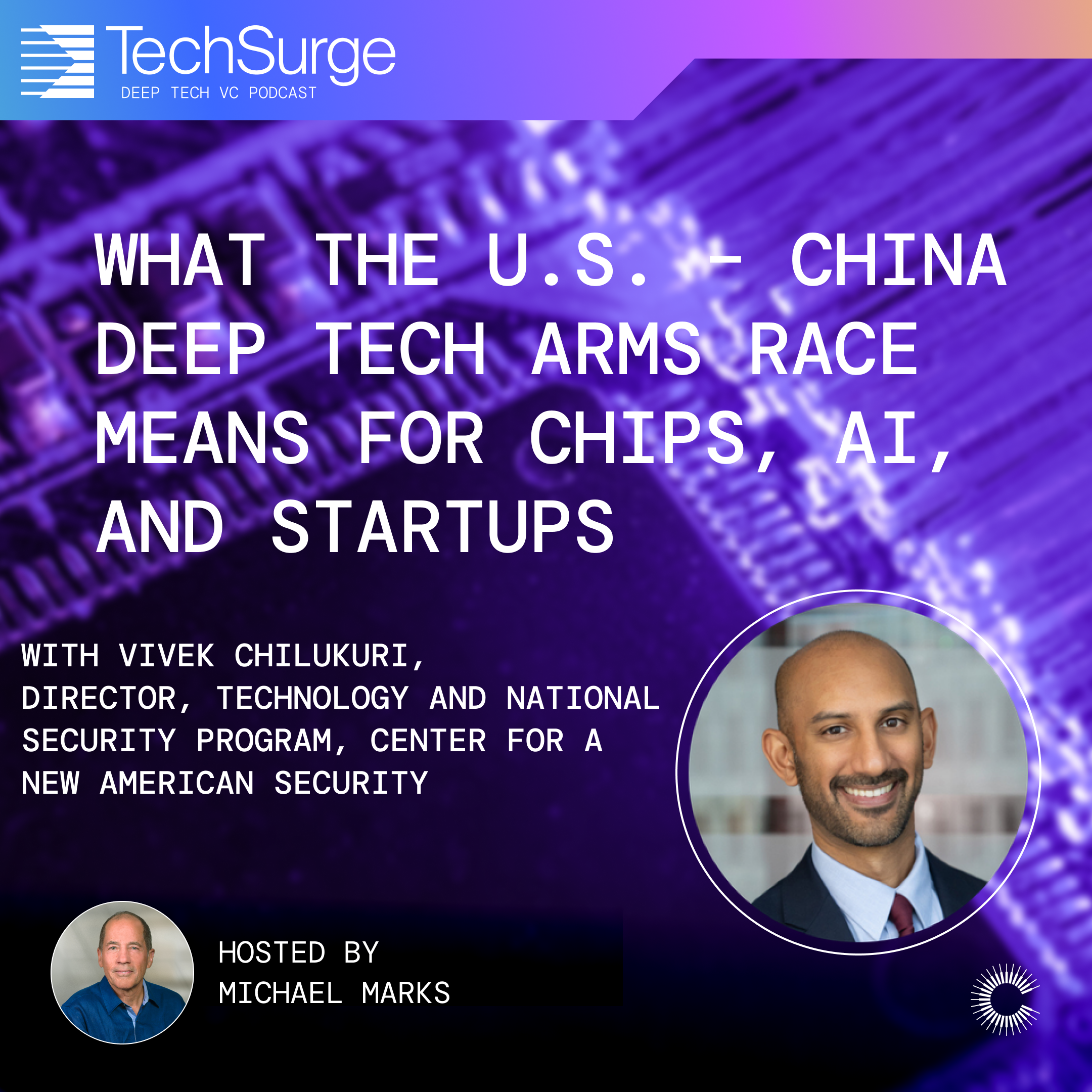
For years, the United States told itself a reassuring story: China could manufacture and copy, but it couldn't innovate. That story is no longer credible. From DeepSeek's compute-efficient AI model to BYD's dominance of the global EV market, China is producing both volume and quality across sectors that matter. The question is no longer whether China can compete — it's whether the United States is playing its own hand well.
In this episode of TechSurge, host Michael Marks speaks with Vivek Chilukury, Senior Fellow at CNAS, where he focuses on U.S.–China technology competition, AI policy, and digital geopolitics. Vivek's path from counter-terrorism work at the State Department to tech policy in the Senate gives him an unusually grounded perspective on how government actually functions — and where it keeps failing itself.
Vivek and Michael work through the full competitive landscape: the wake-up moments that shifted Washington's focus from manufacturing to technology dominance, why the dual-use nature of advanced technology has pulled the national security community into conversations once left to industry, and what Made in China 2025 actually achieved — and where it fell short.
The conversation goes deep on America's policy toolkit: what the CHIPS Act accomplished and why it wasn't enough, how export controls on advanced semiconductors are working and what they're missing, and why Washington is far too weighted toward restriction at the expense of the "run faster" side of the equation. Vivek is also candid about what DeepSeek really tells us — not just about Chinese innovation, but about the gap between building a model and deploying AI at scale.
They also explore the global dimension: China's "easy button" approach to technology exports, what the U.S. AI exports program is trying to do in response, the rise of "AI sovereignty" movements from Brussels to Delhi, and why the talent and immigration decisions of the past year amount to a serious self-inflicted wound.
The United States still holds the best hand in the world for this competition. The question Vivek keeps returning to is whether we're playing it well — and right now, his honest answer is no.
Sign up for our newsletter at techsurgepodcast.com for updates on upcoming TechSurge Live Summits and future Season 2 episodes.
.png)
For thirty years, the United States largely ignored critical minerals. We mined less, processed less, and stockpiled less — while China quietly built the most dominant mineral supply chain in modern history. When China imposed rare earth export restrictions in 2024, manufacturers from Detroit to Tokyo scrambled. The invisible inputs powering electric vehicles, semiconductors, AI data centers, and defense systems had suddenly become visible — and vulnerable.
In this episode of TechSurge, host Sriram Viswanathan speaks with Dr. Gracelin Baskaran, Director of the Critical Mineral Security Program at the Center for Strategic and International Studies. A mining economist with over a decade of field experience across Africa, Latin America, Asia, and the Middle East, Gracelin is one of the sharpest minds working on how the world secures the raw materials that make advanced technology possible.
Gracelin brings a clarifying perspective to a topic that is often framed as a geopolitical contest: the real challenge, she argues, is economic. Until mining in allied countries is genuinely profitable — until the capital, energy infrastructure, processing technology, and policy stability are all in place — supply chain security remains aspirational, regardless of how many executive orders get signed.
Sriram and Gracelin work through the full landscape: what critical minerals actually are and why the term matters, how China built its dominance not just through geology but through industrial strategy and foreign policy, and why the 29-year average timeline from mineral discovery to production creates a fundamental tension with the pace of technology investment. They examine the gap the CHIPS Act left unfilled, the case for aggregating allied demand to change the economics of new mines, and what tech CEOs are dangerously wrong to assume about their own supply chains.
They also dig into the emerging policy architecture: Project Vault as a demand-driven civilian stockpile, the critical minerals ministerial that brought 55 countries to Washington, and the role of recycling and AI-driven exploration in accelerating a supply chain that cannot be built on mining alone.
Ultimately, Gracelin argues that America's greatest advantage is not its geology — it is its capacity to innovate. But innovation without investment, and investment without durable policy, will not be enough. The window is open. The question is whether the commitment holds.
If you enjoy this episode, please subscribe and leave us a review on your favorite podcast platform.
Sign up for our newsletter at techsurgepodcast.com for updates on upcoming TechSurge Live Summits and future Season 2 episodes.
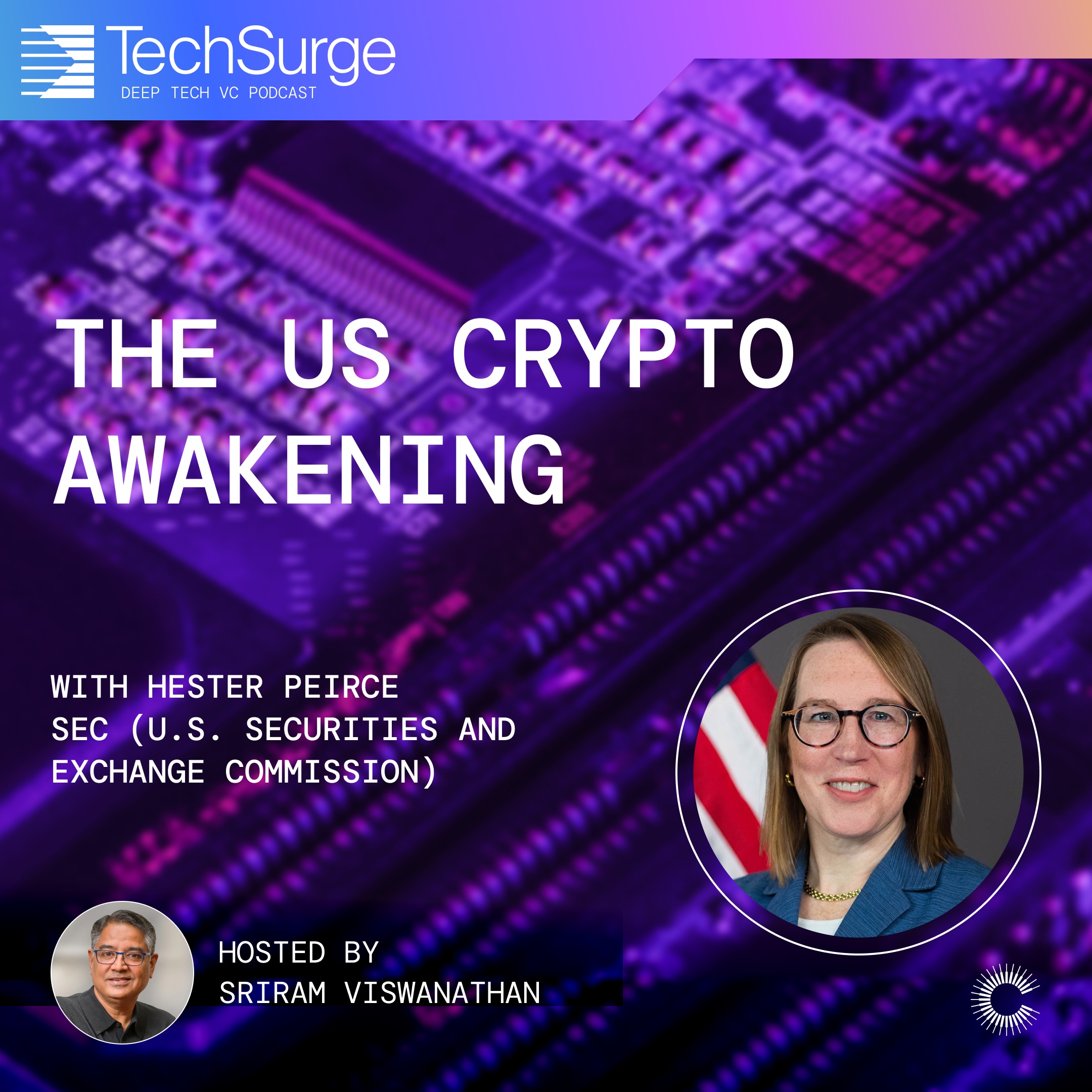
For years, crypto policy in the United States was defined less by clear rules than by the threat of enforcement. Startups and institutions building in the space operated in a gray zone: no clear guidance, no path to compliance, and always the possibility of a regulatory hammer coming down. In 2025, that began to change.
In this episode of TechSurge, host Sriram Viswanathan speaks with Commissioner Hester Peirce of the U.S. Securities and Exchange Commission — one of Washington's most closely watched voices on digital asset policy. Known informally as "Crypto Mom" for her consistent advocacy that markets work best with clear rules and room to innovate, Commissioner Peirce was designated in 2025 to lead the SEC's first Crypto Task Force, signaling a more structured, collaborative approach to digital asset regulation.
Commissioner Peirce brings a rare perspective: a regulator who believes that ambiguity does not protect investors — it protects incumbents and rewards bad actors. In this conversation, she explains what has actually changed in 2025, what it means for companies building in crypto, and what it will take to make this regulatory progress durable beyond any single administration.
Sriram and Commissioner Peirce work through the full landscape: why "crypto" is not one thing but several, how the SEC thinks about Bitcoin as a commodity, what tokenization of traditional securities actually requires, and where real policy gaps remain. They also examine the role of stablecoins and CBDCs, the tension between investor protection and permissionless innovation, and how vertical integration in crypto markets raises the same questions the financial system has always faced — just with new architecture underneath.
Ultimately, Commissioner Peirce argues that the best regulatory framework is one that lets markets identify where technology is useful, enforces rules fairly and consistently, and makes enough room for people to build real things that solve real problems. Once those products exist and are woven into daily economic life, she argues, they become durable — regardless of who is in office.
If you enjoy this episode, please subscribe and leave us a review on your favorite podcast platform.
Sign up for our newsletter at techsurgepodcast.com for updates on upcoming TechSurge Live Summits and future Season 2 episodes.
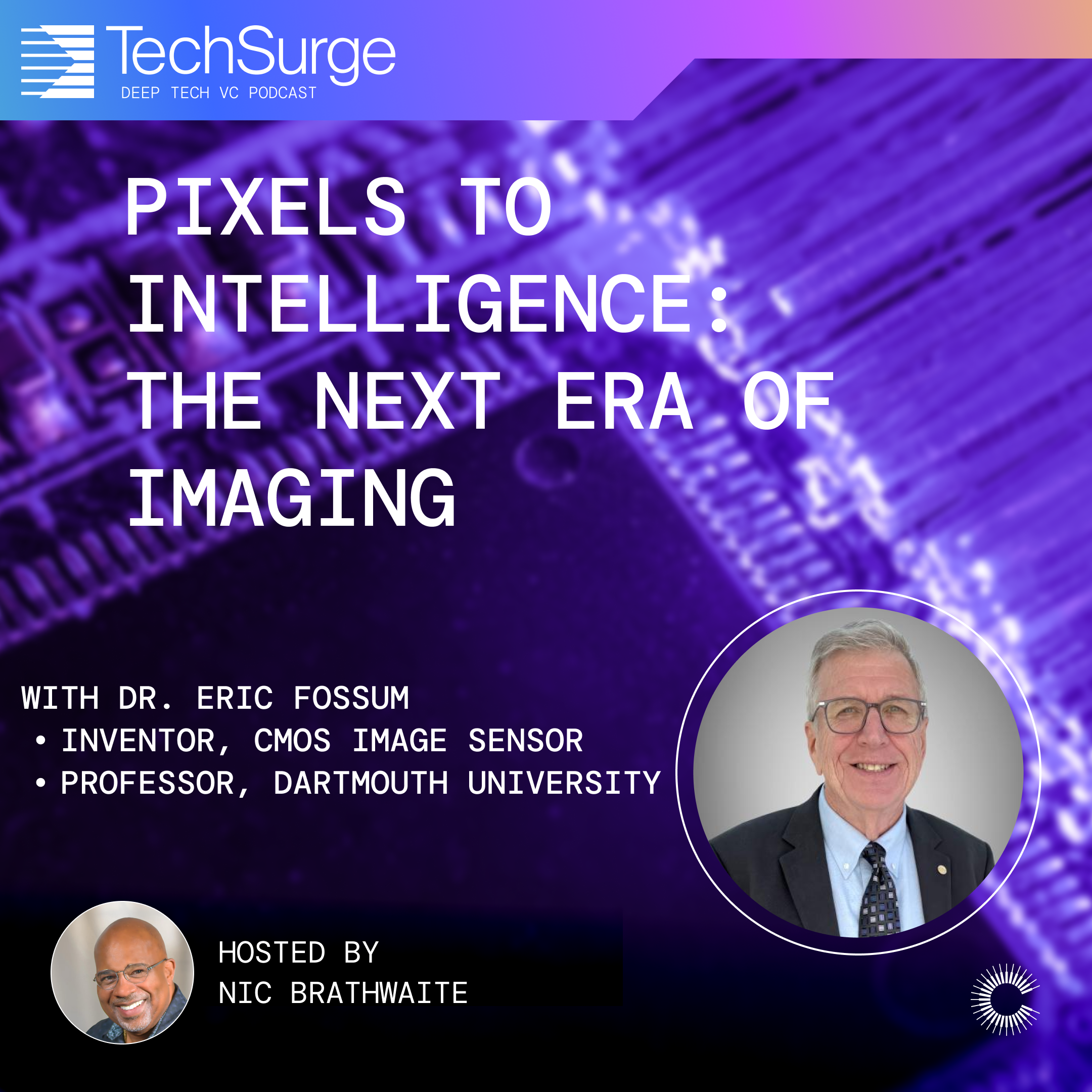
Digital imaging is so ubiquitous today that it’s easy to forget how improbable it once was. In this episode of TechSurge, guest host Nic Brathwaite sits down with Dr. Eric Fossum, inventor of the CMOS active pixel image sensor, to unpack the breakthrough that made it possible to embed cameras into billions of devices and the deeper lessons behind it.
Eric explains how his work began not with consumer electronics, but with a NASA constraint: how to shrink a refrigerator-sized space camera into something small enough for spacecraft. The solution required a fundamental shift in architecture. By moving from CCD-based imaging to CMOS, where sensing and processing could happen on a single chip, he enabled a level of miniaturization and scalability that transformed cameras from standalone systems into embedded infrastructure.
But the conversation goes far beyond the invention itself. Nic and Eric explore what it takes to commercialize deep technology, from the early days of Photobit to its acquisition by Micron, and the critical role ecosystems play in turning breakthroughs into global platforms. They discuss why intellectual property is less about protection and more about leverage, and why even the most important inventions require manufacturing scale, capital, and partnerships to succeed.
The episode also looks forward. As AI systems increasingly rely on visual and physical data, sensors are shifting from tools designed for human perception to components optimized for machine intelligence. Eric highlights the challenges of pushing intelligence to the edge, the limitations of current architectures, and the growing importance of sensing technologies beyond traditional imaging—including molecular detection and new materials that go beyond silicon.
While much of today’s investment is concentrated in models and compute, this conversation makes the case that the next wave of innovation may come from deeper layers of the stack, where machines interact directly with the physical world. The future of AI may depend not just on how systems think, but on how they see, detect, and understand their environment.
If you enjoy this episode, please subscribe and leave us a review on your favorite podcast platform.
Sign up for our newsletter at techsurgepodcast.com for updates on upcoming TechSurge Live Summits and future Season 2 episodes.
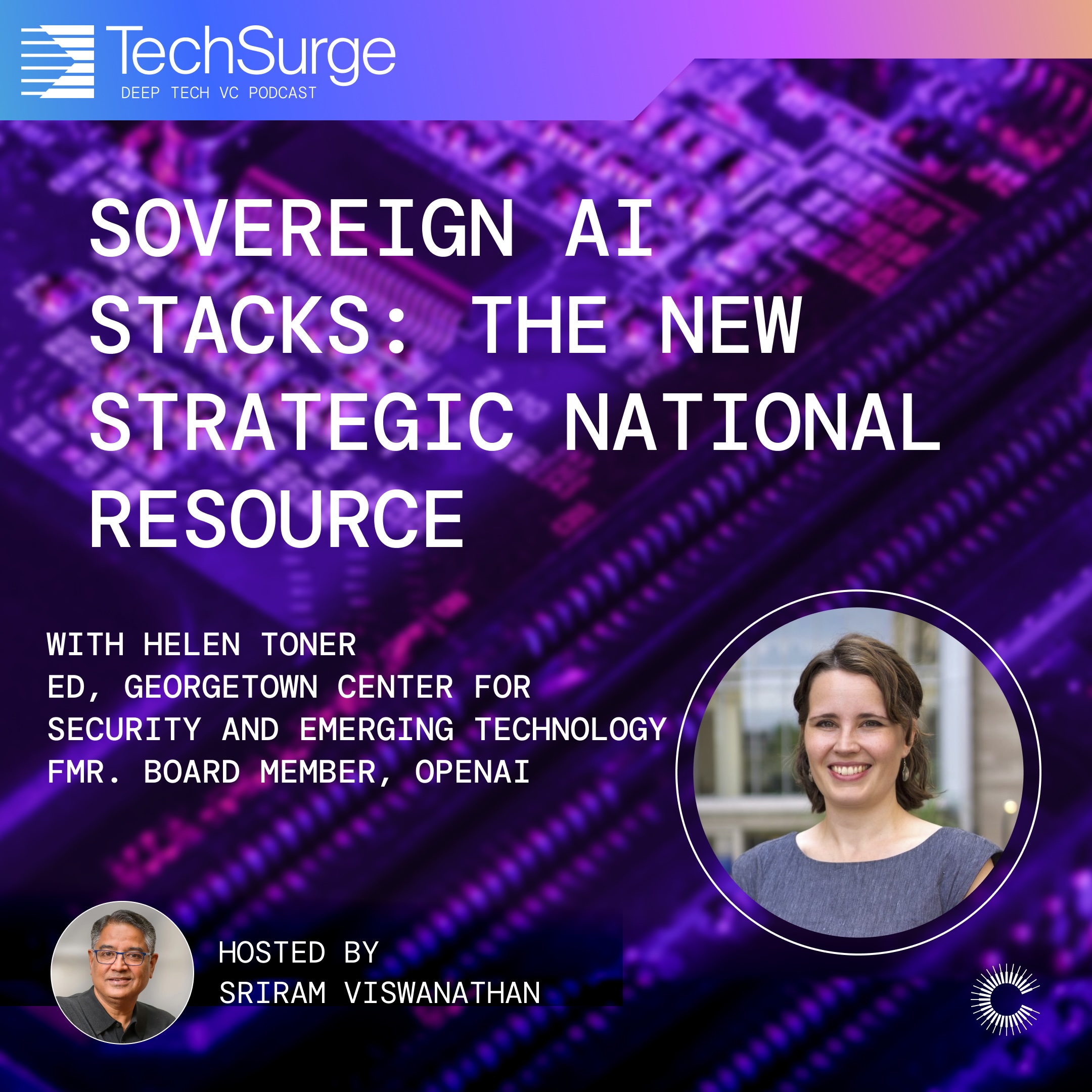
As artificial intelligence becomes a strategic capability for nations as well as companies, questions of governance, safety, and geopolitical competition are moving to the forefront. In this episode of TechSurge, host Sriram Viswanathan speaks with Helen Toner, Interim Executive Director of the Center for Security and Emerging Technology (CSET) at Georgetown and a former OpenAI board member, about the rise of sovereign AI stacks and the global implications of increasingly powerful AI systems.
Helen brings a rare vantage point from both inside the frontier AI ecosystem and the policy world. She reflects on lessons from her time on the OpenAI board, including the governance challenges that arise when nonprofit missions intersect with enormous commercial incentives and rapid technological progress. As AI capabilities accelerate, she argues that the industry is still grappling with deep uncertainty about how these systems work, how they will evolve, and what responsibilities companies and governments should carry.
The conversation explores the idea of sovereign AI; the growing push by countries to control key layers of the AI stack, including compute infrastructure, models, and data. Helen explains why governments increasingly view AI as a strategic national resource, comparable to past transformative technologies like electricity or the internet. At the same time, she cautions that full technological independence may be unrealistic for most nations, given the complexity and global interdependence of the AI supply chain.
Sriram and Helen also examine the evolving US–China AI competition, the role of export controls and semiconductor supply chains, and how different countries, from China to emerging AI hubs in the Middle East, are positioning themselves in the race to build advanced AI capabilities. Along the way, they discuss whether the industry should slow down development, how companies are experimenting with “safety frameworks” for frontier models, and why installing guardrails may be more realistic than attempting to halt progress altogether.
Ultimately, Helen argues that society is entering a period of profound uncertainty. AI is transitioning from a research discipline into a foundational system that will shape economies, security, and daily life. Navigating that transition will require not just technical breakthroughs, but new approaches to governance, transparency, and global cooperation.
If you enjoy this episode, please subscribe and leave us a review on your favorite podcast platform.
Sign up for our newsletter at techsurgepodcast.com for updates on upcoming TechSurge Live Summits and future Season 2 episodes.

Celesta Capital is a global deep tech venture firm enabling visionary founders at the forefront of scientific and engineering breakthroughs.
Celesta's team has spent decades founding, leading, and scaling global technology businesses, collectively founding more than 40 companies. We understand how to partner with founders to help turn prototypes into powerhouses.
From semiconductors and systems to breakthrough biology, we seek out the physics‑defying, code‑rewriting breakthroughs that will power the next decade of technology advancement.
Follow on Substack.
