
TechSurge: Deep Tech Podcast
Exploring topics at the intersection of emerging technology, geopolitics, and business.
Hosted by Celesta Capital.


The TechSurge: Deep Tech VC Podcast shares the latest insights directly from legendary Silicon Valley leaders, daring new founders, and visionary technologists.
Join us as we examine the factors shaping the next major technology cycle shift of AI, examine emerging global tech hubs, and analyze where investment dollars are flowing next.
Each discussion delves into the intersection of technology advancement, market dynamics, and the founder journey, offering insights into the vast opportunities and complex challenges ahead.
For entrepreneurs, investors, or anyone interested in where we're headed next, this is your guide to understanding the technologies and companies poised to transform the future.


.png)
The Race to Build the Next Trillion-Dollar AI Chip Company
Almost 2% of U.S. GDP will be spent on AI infrastructure this year, nearly double 2025's figure. But beneath those headline numbers, the composition of that spending has quietly flipped: for the first time, dollars spent on running models in production now outweigh dollars spent training them.
In this episode of TechSurge, host David Goldman speaks with Austin Lyons, a semiconductor analyst at Creative Strategies, co-host of the Semi Doped podcast, and author of the Chipstrat newsletter. Lyons previously worked as a hardware engineer at Intel and as a product manager on John Deere's autonomous tractor and Blue River Technology teams before turning to full-time chip industry analysis.
The conversation opens with why AI buyers have moved from assembling commoditized parts to buying entire pre-integrated systems, tracing how Nvidia's rack-scale approach, exemplified by its 72-GPU Grace Blackwell racks, made turnkey deployment the default, and why that raises the bar for any chip startup trying to compete. Lyons and Goldman then unpack how inference workloads have split into two distinct problems, prefill and decode, and how that split created an opening for SRAM-based challengers to outperform general-purpose GPUs on decode speed.
From there, the discussion turns to the rise of neoclouds, the GPU-rental companies that grew into public businesses worth well over $100 billion combined, and why so many traditional investors missed them. Lyons and Goldman work through the circular financing debate head-on: the mechanics of Nvidia's equity stakes, GPU-backed debt, and hyperscaler off-take agreements that critics compare to dot-com-era vendor financing, and the counterargument that demand is simply outrunning fixed supply.
The episode closes on Lyons's own framework for identifying the next trillion-dollar chip company, built on four conditions including the ability to run trillion-parameter models at rack scale, beat an incumbent on a key performance metric, and land a frontier anchor customer, along with a look at how AI-assisted chip design is lowering the barrier for more companies, from OpenAI to electric vehicle makers, to design their own custom silicon.
Sign up for our newsletter at techsurgepodcast.com for updates on upcoming TechSurge Live Summits and future episodes.
.png)
In this episode, Nobel Prize-winning physicist Dr. John Martinis reveals how his breakthrough in superconducting qubits made quantum physics real at macroscopic scale and what it means for the future of technology. The former lead of Google's Quantum AI lab explains why quantum computing is so fragile, why a lot of hype has a low chance to work, and why his fabless company Qolab could be the Nvidia of quantum computing.
In this conversation, Dr. Martinis joins Tech Surge to explain the science behind macroscopic quantum coherence, the engineering challenges of scaling quantum computers, and how hybrid quantum-classical computing will shape the future of technology.
The conversation covers:
✅ How the superconducting qubit breakthrough won the Nobel Prize in Physics
✅ Why Nature wants to destroy quantum coherence and why quantum is fragile
✅ From academic physics to building Google's quantum computer
✅ The engineering challenge of scaling quantum computing beyond the lab
✅ Why a lot of quantum computing hype has a low chance to work
✅ How Qolab's fabless model could scale quantum hardware
Sign up for our newsletter at techsurgepodcast.com for updates on upcoming TechSurge Live Summits and future episodes.
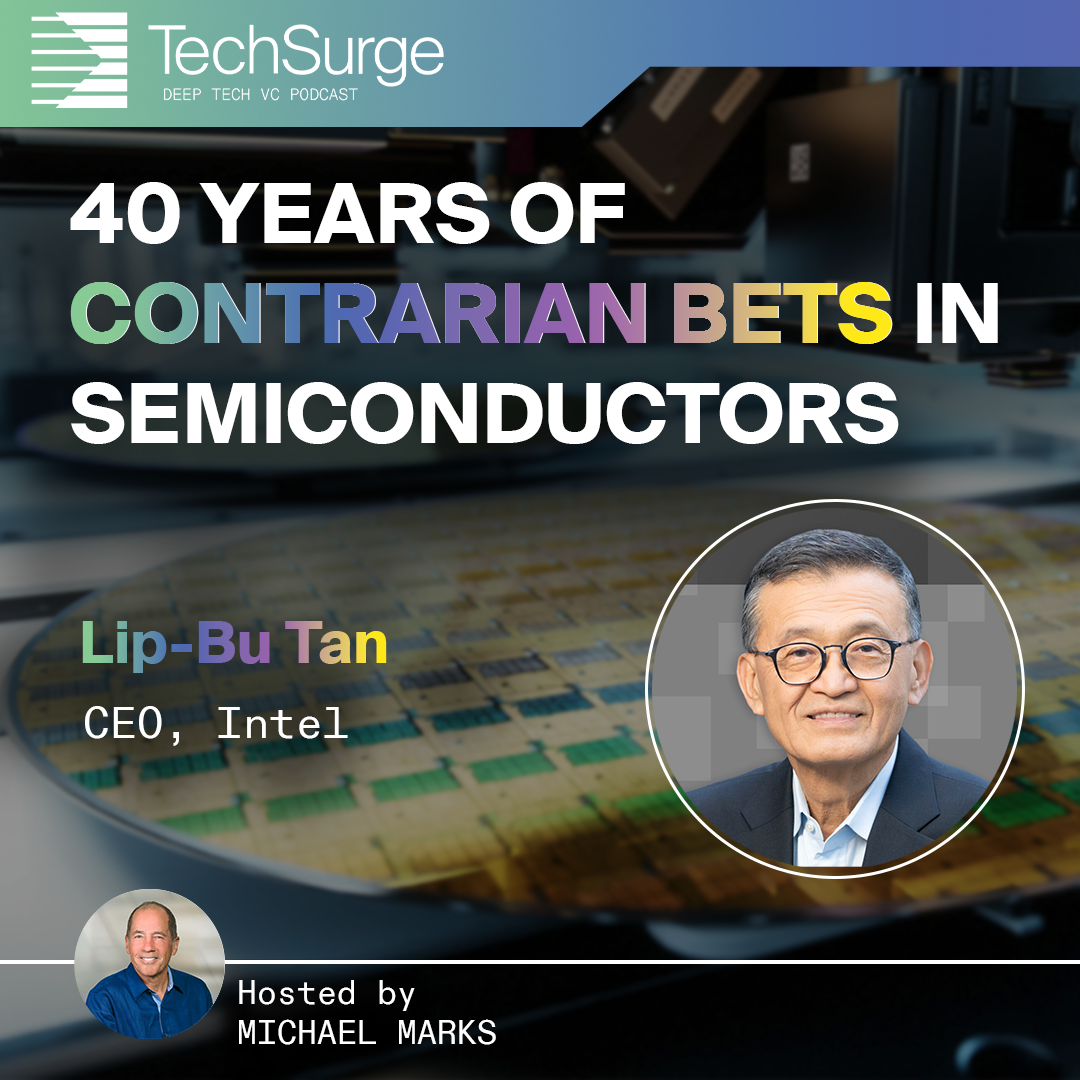
Silicon Valley was built on semiconductors, but for nearly two decades, venture capital shifted its attention towards software. Today, AI is changing that as the demand for compute, memory and networking explodes, hardware is once again at the centre of the industry's biggest bets.
In this episode of TechSurge, host Michael Marks speaks with Lip-Bu Tan, CEO of Intel and one of the semiconductor industry's most influential investors and executives. The conversation traces Tan's journey from studying nuclear engineering at MIT to leading Cadence's turnaround, investing in more than 500 technology companies, and now steering Intel through one of the most significant transformations in its history.
Tan shares his VC conviction on backing semiconductor startups when most venture investors favored software, and why he believes AI's next breakthroughs will come from advances in memory, packaging, photonics, cooling and high-speed connectivity. He also opens up on the leadership philosophy that defined his time at Cadence, where listening to customers and building a culture of responsiveness became the foundation of the company's revival.
Wearing his CEO hat, Tan explains Intel's long-term strategy, why vertical integration still matters, how the company plans to reconnect with the startup ecosystem, and why missing another technology wave is not an option.
Sign up for our newsletter at techsurgepodcast.com for updates on upcoming TechSurge Live Summits and future episodes.

Artificial intelligence is often discussed through models and GPUs. This episode looks beneath that surface, at the power delivery and networking required to make AI work at scale.
Host Sriram Viswanathan speaks with Rajiv Khemani, a serial deep tech entrepreneur whose career has tracked several major infrastructure cycles: internet networking, cloud switching, blockchain compute and now AI networking. Khemani reflects on his early work at NetBoost and Intel, his operating role at Cavium, and the founding of Innovium, which Marvell agreed to acquire for $1.1 billion in 2021. He also explains how work on low-power blockchain silicon led his team toward the infrastructure demands created by generative AI.
The discussion examines why incumbents often overlook emerging markets, why purpose-built hardware can outperform systems inherited from an earlier technology cycle, and how founders decide whether to keep financing a company or sell while the outcome remains attractive. Khemani describes the concentration risk of selling to a small number of hyperscalers, the fragility of semiconductor supply chains, and why leading-edge chip development now demands much larger balance sheets.
The conversation then turns to AI’s emerging bottlenecks. Large models require many accelerators to operate as one computer, making low-latency scale-up and scale-out networks central to performance. The episode explores heterogeneous compute, open networking standards, memory scarcity, AI’s growing electricity demand, and the competition between AI and Bitcoin mining for energy.
Sign up for our newsletter at techsurgepodcast.com for updates on upcoming TechSurge Live Summits and future episodes.

Canada produces world-leading science, engineering, and AI research. So why does so much of that research still commercialize outside of Canada?
In this episode of TechSurge, host Nic Brathwaite puts that question to four leaders at two of Canada's top research universities: Mary Wells (Dean of Engineering) and Chris Houser (Dean of Science) at the University of Waterloo, and Heather Sheardown (Dean of Engineering) and Gianni Parise (VP Research) at McMaster.
At Waterloo, Mary Wells traces how the university's origin produced one of the world's most influential co-op programs and a creator-owned IP policy that lets inventors keep their ideas, making the school a talent engine for global tech. The group digs into Canada's AI paradox, foundational research and talent but far less of the economic value, and what quantum, robotics, and advanced manufacturing show about getting research to market.
McMaster runs a different model, built on health sciences, nuclear research, and problem-based learning. Heather Sheardown explains the McMaster Method and why it matters in an AI-shaped future. Gianni Parise argues for commercialization as a core university function, with work spanning AI-assisted drug discovery, inhaled vaccines, critical-mineral-free motors, and a campus nuclear reactor that supplies much of the world's iodine-125 for prostate cancer treatment. They also unpack Fusion Pharmaceuticals, the McMaster spin-out acquired by AstraZeneca, and what it reveals about university commercialization.
Together, these conversations ask what universities must become in an era defined by AI, deep tech, national competitiveness, and the urgent need to move ideas from the lab into the world.
Sign up for our newsletter at techsurgepodcast.com for updates on upcoming TechSurge Live Summits and future episodes.
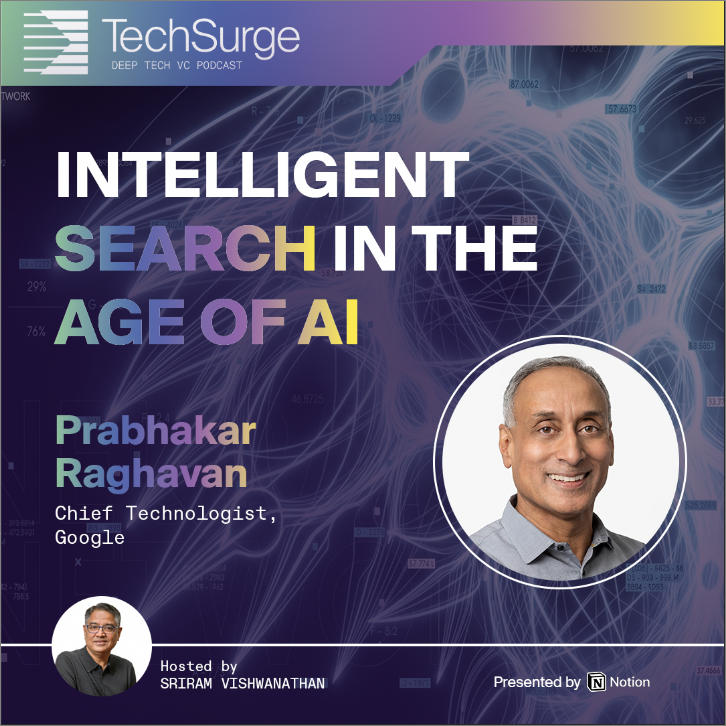
Search began as a way to find pages. AI is turning it into a way to ask, reason, decide, and act.
Search has always been more than a technical problem. It is a way of organising knowledge, connecting intent with information, and increasingly, turning questions into actions. In the age of artificial intelligence, that basic function is being redefined.
In this episode of TechSurge, host Sriram Vishwanath speaks with Prabhakar Raghavan, Chief Technologist at Google, about the long arc of search: from the early web and link analysis to knowledge graphs, language models, transformers, Gemini, and the unresolved question of how AI will change the way we find, trust, and use information.
Prabhakar reflects on his career as a computer scientist, researcher, and technology leader, beginning with his time at IBM Research, where he worked on algorithms, optimization, databases, and early information retrieval. He explains how the explosion of unstructured data on the web created a new class of technical and economic problems. Search was not simply about indexing pages; it was about imposing structure on a chaotic information environment and building mechanisms that could connect supply, demand, relevance, authority, and trust.
The conversation traces how early search evolved through link analysis and PageRank, drawing on ideas from scholarly citation analysis, graph theory, and algorithmic ranking. Prabhakar describes why authority and trust became central to search as the web grew, and why users themselves changed alongside the technology. As search engines became more capable, people moved from looking for simple webpages to asking richer, more contextual questions that required intent understanding rather than mere document retrieval.
Sriram and Prabhakar then explore the transition from classical search to AI-infused products. Through examples such as Gmail Smart Reply, Smart Compose, Google Drive recommendations, and knowledge graphs, Prabhakar shows how prediction, context, and language modelling were already reshaping user experiences well before the current generative AI wave. These systems were early signals of a broader shift: computers moving from retrieving information to anticipating what users might need next.
The episode also offers a technical tour of the major algorithmic milestones that led to today’s AI systems, including deep learning, sequence-to-sequence models, attention mechanisms, transformers, and the compute architectures needed to train and serve large models. Prabhakar explains why attention changed the quality of language modelling, why AI systems appear increasingly conversational, and why compute remains one of the central constraints in the field.
At the heart of the discussion is the central tension facing search today: if AI systems can generate answers directly, what becomes of search as we know it? Prabhakar does not frame AI as the end of search, but as its next transformation. The future of search may be less about finding a page and more about understanding intent, synthesising knowledge, reasoning through ambiguity, and helping users complete complex tasks.
The conversation closes with deeper questions about AI world models, hallucination, test-time compute, diffusion models, recursive self-improvement, theorem proving, and whether AI systems can ever reason with the same grounded understanding as humans. For Prabhakar, the challenge is not only to build more powerful models, but to understand their limits, failure modes, and relationship to truth.
This episode is a wide-ranging exploration of how search became one of the defining technologies of the internet age—and how artificial intelligence may now force us to rethink what it means to search at all.
Sign up for our newsletter at techsurgepodcast.com for updates on upcoming TechSurge Live Summits and future episodes.
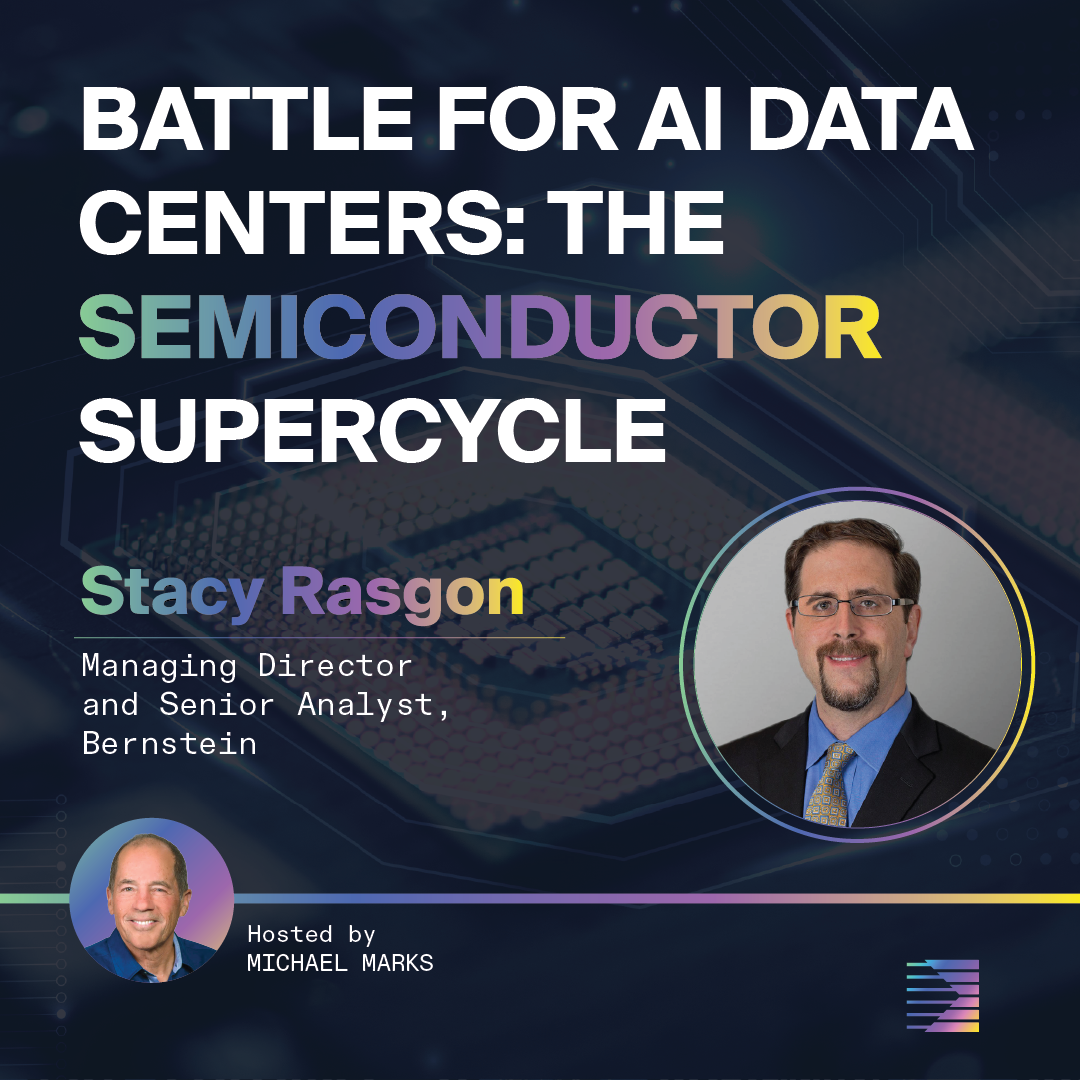
Semiconductors have moved from the background of the technology stack to the center of the AI economy. What used to be a specialized industry discussed mostly by engineers and investors is now shaping the speed, cost, and strategic direction of modern computing.
In this episode of TechSurge, host Michael Marks speaks with Stacy Rasgon, Managing Director and Senior Analyst covering U.S. semiconductors and semiconductor capital equipment at Bernstein Research. Stacy has spent years analyzing the chip industry across cycles, but argues that the current moment feels different in scale: AI demand has created an unprecedented scramble for compute, memory pricing has surged, and companies across the stack are being forced to rethink capacity, architecture, and capital allocation.
The conversation explains the 4 different kinds of semiconductor cycles—supply, inventory, product, and demand — and why Stacy believes the industry is currently in a demand cycle of unusual magnitude. The discussion also unpacks the distinction between DRAM and NAND, why high-bandwidth memory is becoming strategically central to AI systems, and how the physical realities of wafer capacity and silicon area are constraining supply in ways the broader market often misses.
Stacy and Michael also discuss the hardware economics behind the current boom, with Michael pressing Stacy on why compute remains so scarce and how companies are improving performance through packaging and system design. Michael then moves the conversation beyond market headlines to the core business questions: who is actually paying for this compute, which use cases are generating real revenue, and whether AI spending is creating durable economic value or simply shifting costs elsewhere. Together, these questions highlight two of the episode's clearest insights: coding may be one of the earliest AI applications with meaningful willingness to pay, and inference, not training, is the real test of whether the current buildout becomes a lasting business or just another expensive wave of infrastructure.
Stacy explains the concentration of power among the major wafer fabrication equipment players, the rise of ASICs as a meaningful share of AI silicon, Broadcom's rapidly expanding AI opportunity, and the growing role of Chinese companies as new entrants, especially in memory and semiconductor equipment. Along the way, the conversation asks the defining question facing the sector: is this just another semiconductor upswing, or the first true supercycle the industry has seen? Stacy believes that this might be the biggest supercycle he has seen in his career.
Sign up for our newsletter at techsurgepodcast.com for updates on upcoming TechSurge Live Summits and future episodes.

Celesta Capital is a global deep tech venture firm enabling visionary founders at the forefront of scientific and engineering breakthroughs.
Celesta's team has spent decades founding, leading, and scaling global technology businesses, collectively founding more than 40 companies. We understand how to partner with founders to help turn prototypes into powerhouses.
From semiconductors and systems to breakthrough biology, we seek out the physics‑defying, code‑rewriting breakthroughs that will power the next decade of technology advancement.
Follow on Substack.
